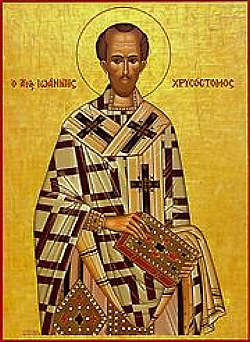
347-407 A.D. Commemorated Sept.14, Jan.27, & Jan.30
|
St. John Chrysostom
347 to 407 A.D. |
St. Basil the Great
330 to 379 A.D. |
St. Gregory of Nyssa
330 to 394 A.D. |
|
St. Maximus the Confessor
580 to 662 A.D. |
St. Nicholas the Wonderworker
270 to 343 A.D. |
St. Athanasius
296 to 373 A.D. |
|
St. Mary of Egypt
344 to 421 A.D. |
St. Theophan the Recluse
1815 to 1894 A.D. |
St. John Maximovitch
1896 to 1966 A.D. |
|
St. Gregory Palamas
1296 to 1359 A.D. |
St. Declan of Ardmore
440 to 490 A.D. |
|
Saint John Chrysostom
347-407 A.D. Commemorated Sept.14, Jan.27, & Jan.30
St. John, called "Chrysostom" or "Golden Mouth", was born in Antioch, the city where the followers of Christ were first called Christians, in 347. After completing his education, he entered the practice of law and then, in his early twenties, became a catechumen. After three years of preparation he was baptized-an event that was the turning point of his life, leading to a complete renunciation of his former ways, even to the point of almost continual silence, so as to avoid the temptation to indulge in gossip or slander.
Becoming a monk, Chrysostom preached every Sunday, and sometimes two or three times during the week. When he was not preaching to great multitudes, he composed commentaries on Scripture. But in 397 he was chosen Patriarch of Constantinople, became involved in some of the important theological controversies of his day, and suffered unfair exile. He bore all this patiently and meekly. On September 14, 407, St. John Chrysostom (then in exile) received Holy Communion while wearing his white baptismal garment and spoke these last words: "Glory be to God for all things. Amen." Almost immediately after his death he was hailed as a saint by the Christians of his time. For his defense of the Orthodox faith and his profound interpretations of Scripture, he is known as one of the great "Three Hierarchs" of the Church, together with his older contemporaries, St. Basil the Great and St. Gregory the Theologian (their memory is celebrated together on January 30). He edited and handed down the text of the Divine Liturgy, which is still known by his name.
The following, taken from a long exposition on Ephesians 1: 15-20, explains what are the implications for those who belong to the Church-the Body of Christ-and also what it means to receive the Body of Christ-Holy Communion-in Divine Liturgy
"Since we are speaking to you of the Body of Christ, come then, let us turn our minds to That, to the Body that was crucified, the Body that was fastened with nails, to That which was sacrificed. If you are the Body of Christ, bear the Cross; for He bore it! Suffer to be spat upon, bear with the blows, bear with the nails! Such things did it endure, the Body that was sinless. His Body 'that did no sin, neither was guile found in His mouth' (I Pet. 2:22)
"And since we are speaking of this Body, whoever among us shall partake of this Body and drink of this Blood, let them bear in mind that in nothing does it differ from that Body which sits on high, Which is adored by the Angels, seated close to the Unclouded Glory: it is of This we taste. Oh, how many are the ways of salvation open to us!"
Saint Basil the Great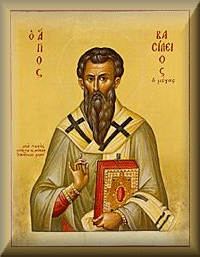
330-379 A.D. Commemorated Jan. 1 / Jan. 14
St. Basil the Great was born in Caesarea in Cappadocia in 330 AD. He came from a very holy family. His paternal grandmother was St. Macrina the Elder, his elder sister was St. Macrina the Younger, and St. Gregory of Nyssa was his brother. Also, one of his other brothers (there were 10 children total) was a bishop.
He received a very good education, aiming for a career as a rhetorician, as his father was. After becoming a Christian, St. Basil toured the eremitical (hermit-like) establishments of monasticism in Egypt, Syria, and Mesopotamia, and decided to follow such a way of life. Many people flocked to him as a spiritual father, and he wrote the rules of monasticism which most Orthodox monks follow to this day. St. Basil was a prolific writer and wrote quite a bit about the Holy Spirit and its relationship in the Holy Trinity. Most of his texts are not on the Internet, though (many haven't even been translated into English yet; they are in Classical Greek). He reposed in the Lord in 379 AD.
Saint Gregory of Nyssa
330-394 A.D. Commemorated Jan. 10 / Jan. 26
Love is the foremost of all excellent achievements and the first of the commandments of the Law…the life of God consists in the eternal practice of love; and this life is wholly beautiful, possessed of a loving disposition toward beauty and never receiving any check in the practice of love. And because beauty is boundless, love shall never cease. (On the Soul and the Resurrection).
This Holy Father came from an illustrious and holy Cappadocian family that included his sister, St. Macrina, and his brother, St. Basil. After an early experience of desert monasticism, he was consecrated bishop of Nyssa by his brother. Active in the Second Ecumenical Council (381) against the Arians, St. Gregory of Nyssa spent the last decade of his life exercising vigorous church leadership.
While St. Gregory was a prolific writer, he was sometimes subject to mistakes, notably in his erroneous teaching concerning "universal salvation." This, however, did not prevent him from being accepted as a father and teacher of the Orthodox Church. Among his dogmatic works are The Great Catechism and The Making of Man. In these and his other works, as one commentator writes, "his mind hovers over immense fields of vision" (Robert Payne, The Holy Fire), making his Orthodox writings simply magnificent and filled with insight, as in the following brief passage:
"You are pleased because you are handsome, because your hands move quickly, because your feet are nimble, because your curls are tossed by the wind and your cheeks show a downy beard....You look at such things, but you do not look at yourself. Let me show you as in a mirror your true image.
"Have you ever witnessed the mysteries of the cemetery? Have you seen the heaps of bones tossed hither and thither? Skulls without flesh on them, fearful and ugly, the sockets empty. The grinning jaws and the limbs strewn about. Look at these things: there you will find yourself. Where, then, is the flower of youth?... Where, in all these bones, are the things that make you proud?" (On the Beatitudes, I)
Even in these images of death, one cannot help but sense St. Gregory's exuberant delight in humanity and the nobility of man--that crown of God's creation which He formed, not from any necessity, but "in the superabundance of love."
"For needful it was that neither His light Should be unseen, nor His glory without witness, nor His goodness unenjoyed, nor that any other quality observed in the Divine nature should in any case lie idle, with none to share it or enjoy it. If, therefore, man comes to his birth upon these conditions, namely to be a partaker of the good things in God, necessarily he is framed of such a kind as to be adapted to the participation of such good. For as the eye, by virtue of the bright ray which is by nature wrapped up in it, is in fellowship with the light, and by its innate capacity draws to itself that which is akin to it, so was it needful that a certain affinity with the Divine should be mingled with the nature of man, in order that by means of this correspondence it might aim at that which was native to it .... In truth this has been shown in the comprehensive utterance of one expression, in the description of the cosmogony, where it is said that man was made in the image of God." (The Great Catechism, V)
Troparion, Tone 1
The shepherd's pipe of thy theology/
conquered the philosophers' trumpets;/
for since thou didst search out the depths of the Spirit,/
beauty of speech was added to thee./
Intercede with Christ our God that our souls may be saved,/
O Father Gregory.
Kontakion, Tone 3
With thy theologian's speech thou didst dispel the philosopher's cobwebs,/
O glorious Gregory;/
and thou dost adorn the robe of Orthodoxy woven for the Church from on high./
Wearing this, she cries out with us thy children:/
Rejoice, O Father, most excellent mind of theology.
Saint Maximus the Confessor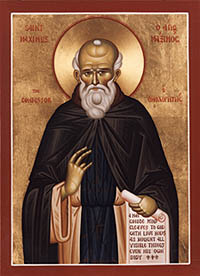
580-662 A.D. Commemorated Jan. 21 / Feb. 3
Saint Maximus was born at the end of the sixth century in Constantinople of noble parents and received an excellent philosophical and theological education. Under the Emperor Heraclius (610-641), he was among the imperial counsellors. Seeing the spread of the heresy of the Monothelites, with which even the Emperor himself was infected, (the Monothelites rejected a human will in Jesus Christ, whereby they diminished the significance of His sufferings on the Cross; the Monothelites incorrectly thought that the human nature of Jesus Christ was swallowed up and annihilated by His Divine nature), he left the imperial palace and joined the monks in the Chrysopolis Monastery. Subsequently, Venerable Maximus became the superior of this monastery.
A profound theologian of his time and a strict defender of Orthodoxy, Maximus very ably and successfully demonstrated the incorrectness of the Monothelite heresy, for which he was subjected to persecutions many times by the enemies of the Church.
Venerable Maximus' arguments in behalf of Orthodoxy were so powerful that after a public debate on the faith with Pyrrhus, the Monothelite Patriarch of Constantinople, the latter renounced the heresy in 645. Venerable Maximus was sent into exile several times and each time would again be called back to Constantinople. The heretics often passed from admonitions and promises to threats, abuse and the beating of Venerable Maximus. On one occasion, Saint Maximus was called back to Constantinople, where the imperial grandees, Troilus and Sergius, again subjected him to interrogation. They began to accuse Saint Maximus of pride for esteeming himself as the only Orthodox who is being saved and for considering all others to be heretics who are perishing.
To this, the Saint replied: "When all the people in Babylon were worshipping the golden idol, the Three Holy Youths did not condemn anyone to perdition. They did not concern themselves with what others were doing, but took care only for themselves, so as not to fall away from true piety. In precisely the same way, Daniel also, when cast into the den, did not condemn any of those who, in fulfilling the law of Darius, did not want to pray to God; but he bore in mind his duty, and desired rather to die than to sin and be tormented by his conscience for transgressing God's Law. God forbid that I, too, should condemn anyone, or say that I alone am being saved. However, I would sooner agree to die than, having apostatized in any way from the right faith, endure the torments of my conscience."
Then Troilus and Sergius began to point out to Saint Maximus that already the whole Christian world recognized the Monothelite Patriarch of Constantinople as legitimate, that all the Eastern Patriarchs and their locum tenentes were in communion with him, and that the plenipotentiary representatives of the Roman Pope will serve with the Patriarch and commune with him. Thus, he is the only one remaining in the whole world who does not recognize the Patriarch. The Saint answered: "If even the whole universe should begin to commune with the Patriarch, I will not commune with him. For I know from the writings of the holy Apostle Paul that the Holy Spirit will give over to anathema even the angels, if they should begin to preach any other gospel, introducing anything new."
Venerable Maximus remained unshaken in his religious convictions. Finally, they cut off his right hand and tongue, so that he could not proclaim or defend the truth either by word or by pen. Then they dispatched him to confinement in Lazov (a region of Mingrelia) in the Caucasus. Here, Venerable Maximus died on the 13th of August 662, knowing in advance of his end.
Venerable Maximus wrote many theological works in defense of Orthodoxy. Especially valuable are his instructions on the spiritual and contemplative life, some of which were included in the "Philocalia" (a collection of patristic instructions on prayer and the ascetic life). In these ascetical instructions, the spiritual profundity and perceptiveness of Saint Maximus' thought is revealed. Also, an explanation of the Liturgy that has a great theological significance has come down to us from him. The example of Venerable Maximus' courageous stand shows how an Orthodox Christian must behave in the face of apostasy - general deviation from Christ's Truth.
Venerable Father Maximus, entreat God for us!
Parish Life, February, 1995
Troparion in tone 8
You revealed yourself to be a guide to the Orthodox Faith,
A teacher of true worship and purity, O divinely inspired Maximus.
O Wise instructor of Bishops and star of the Universe,
You have enlightened all as an instrument of the Spirit:
Intercede now with Christ God that our souls may be saved!
Kontakion in tone 2
O Maximus, defender of the Church,
Preacher of divine truth, pillar and splendor of Orthodoxy,
The herald and song of devotion,
The holy and divine beauty of hermits,
Never cease to intercede for us all!
Saint Gregory Palamas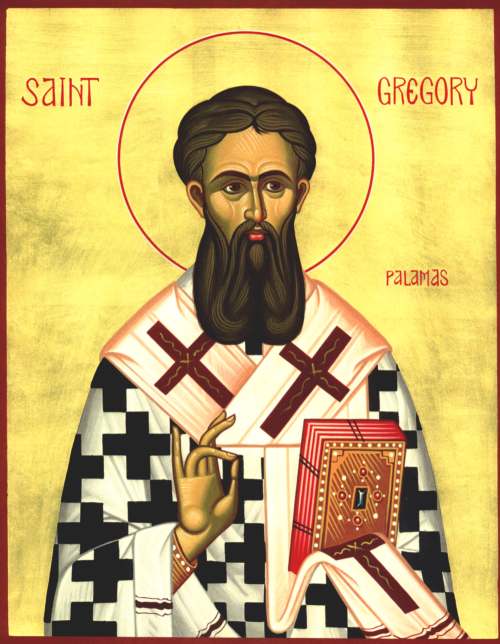
1296-1359 A.D. Commemorated ___
Troparion Tone 8
O star of Orthodoxy, support of the
Church and its teacher, O comeliness of ascetics,
and incontestable champion of those who speak
in theology, Gregory the wonder-worker, the
pride of Thessalonica and preacher of grace,
implore thou constantly for the salvation of our souls.
Reference: J. Meyendorff, A Study of Gregory Palamas, (1964)
Saint Athanasius, Bishop of Alexandria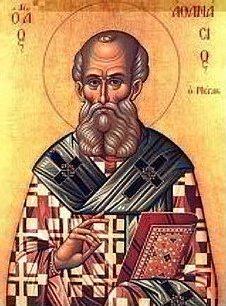
296-373 A.D. Commemorated May 2 / May 15
St. Athanasius was born at the very end of the third century, near the city of Alexandria in Egypt. One day the bishop of Alexandria was in his home gazing through a window at the beach. He was surprised to see a group of small boys moving back and forth with solemnity and dignity. He asked his assistant to bring the children to his palace, where he asked them what they were doing.
"We have selected Athanasius as our bishop and we are following his order," one of them said.
"What order?" asked the bishop.
"We are baptizing some heathen children," Athanasius explained. "I have chosen some of these Christian boys to be priests, and we were baptizing the others, just as the priests do in Church."
He went on to tell the bishop exactly how he had done it. He had instructed the heathen boys in the Christian faith, then following the church service of baptism exactly, he had led the children into the water to be baptized. The bishop was very pleased that Athanasius knew and understood the service so well. He called the boy's parents and advised them to give a good education to their son in preparation for the priesthood. The bishop became especially fond of Athanasius. The boy spent so much time at the bishop's home that he became like a son to the venerable old man. Under the bishop's guidance, Athanasius studied hard and was writing important theological works even before he was twenty.
At about this time, the Roman Emperor Constantine stopped the persecutions of Christian and they no longer had to worry about being tortured and killed for refusing to worship the Roman Emperor. Athanasius wrote a book, explaining what the coming of Christ on earth as man meant for the whole world. "He did not come to make a display of glory; He came to heal," Athanasius wrote of Christ. "Physically, he was entirely human with a body which suffered and died, but at the same time he remained God, with power over everything. By His coming, He overcame death, because He was promising eternal life." This short work of Athanasius, "Concerning the Incarnation," is very moving, and is one of the best books about the Christian faith.
Just after young Athanasius wrote this book, a new teaching about Christ was spreading. Arius, a priest in Alexandria, believed that if Christ was the Son of God, then God must be older than Christ. If this were so, Christ could not be as important as God. "There was a time when Christ was not, " shouted Arius, and therefore Christ could not be really God. The leaders of the Church were horrified by the new heresy, later known as Arianism. If Christ was a sort of superhuman instead of God, what would happen to the Christian Church? This was against all the accepted Church traditions about Jesus.
Although most leaders of the Church were against it, Arius' teaching gained wide acclaim. People could easily believe that Christ was a hero who had shown us the way to God. Even the Emperor Constantine heard of it. He was friendly to the Church and was troubled to hear of the controversies that were upsetting it. Bishops were arguing with other bishops, and the people were fighting each other. Even members of the same family began to argue about these questions. How could he stop this argument? He decided to call a Church council of all the bishops.
The first great Council was called at Nicea in Asia Minor in 325 AD. Three hundred and eighteen bishops came from all over the empire, bringing priests and laymen with them. Arius was there to present his side, and he did so by singing a poem about his beliefs to the tune of a popular song. Athanasius, still a young deacon, answered him very seriously, pointing out all the evil which would come from a belief in Arianism. Most of the bishops were against Arius, and they decided to write a creed that would show exactly what Christians believed about Christ. This creed forms part of what we say at every Divine Liturgy. "I believe in one Lord, Jesus Christ, the only-begotten Son of God; being made of one essence with the Father by whom all things were made." This creed was to express the Faith of the Church, which Athanasius had so eloquently defended, and to reject Arianism. The Council of Nicea, the first of the seven great Ecumenical Councils, supported Athanasius and threw Arius out of the Church.
Athanasius returned to Alexandria triumphant and successful, and soon afterward he became bishop of Alexandria. He was much loved by the people of the cities and by the hermits of the desert, whom he liked to visit and with whom he occasionally lived. But Arius was still strong. The Emperor Constantine allowed him to continue preaching, and he had many powerful friends. People began to spread rumors attacking Athanasius, saying he was against the Emperor and was disobeying the law, even committing murder. The Emperor called him to Constantinople and asked him to defend himself against the accusations.
As Athanasius stood before the court, he felt that his enemies were all around him. The followers of Arius hated him because he had led the Church's attack on their leader. They shouted at him, calling him a murderer. He answered them by bringing into the courtroom the man they said he had murdered. The people were amazed and ashamed. The Arians were angry, but they could do nothing against the strong and popular bishop. They held another trial, and blamed Athanasius of opposing the Emperor. The Emperor himself was present and sent Bishop Athanasius far away in exile to France.
A few years later, the Emperor Constantine died and Athanasius was allowed to return to his own city. Alexandria met him with a great and solemn ceremony; the whole city was turned into a church. Although he had been away a long time, the Fathers in the desert remembered his great work for the Church and reminded the people of their bishop. The next Emperor was under the influence of the Arians, and he hated and feared Athanasius. He sent an Arian to replace him as bishop, and the new bishop started a reign of terror, closing and destroying churches and torturing priests, monks and believers.
How could Athanasius fight now, with the Emperor and all his armies against him? "Only the knowledge of the truth can save us!" he exclaimed. He escaped to Rome, once again an exile. He was supported by the bishop of Rome, while the new bishops in the East supported Arianism. Later he was allowed to return to Alexandria, but the Emperor was always trying to get rid of him. Once, when Athanasius was at a church service at night, soldiers broke in and surrounded the people and the sanctuary. Bishop Athanasius remained seated and ordered the deacon to read a psalm. At first the soldiers did not date to attack worshipers in church, but finally they did so, killing, wrecking and stealing. The clergy managed to get Athanasius away and into the desert before the soldiers could get him. He spent twenty years of his life in exile, away from his Bishop's seat, but he never stopped writing and fighting to preserve the Christian faith against its enemies.
At the end of his life, he was finally able to return to Alexandria and live peacefully as an honored, loved, and powerful bishop. All his life he had steadfastly opposed the Arians, challenged the Emperors, and maintained the traditional Orthodox faith which he knew must triumph. If Athanasius had not stood up for our faith, perhaps the Church would not be the same today.
Athanasius was the greatest champion of Catholic Apostolic belief on the subject of the Incarnation that the Church has ever known and in his lifetime earned the characteristic title of "Father of Orthodoxy", by which he has been distinguished every since.
Troparion Tone 3
O Hierarch Athanasius, thou wast a pillar of Orthodoxy/
supporting the Church with divine doctrines;/
for thou didst proclaim the Son to be of one essence with the Father,/
and didst put Arius to shame./
O righteous Father, entreat Christ our God to grant us His great mercy.
Kontakion Tone 2
Thou didst plant the dogmas of Orthodoxy/
and cut out the thorns of false doctrine;/
thou didst water the seeds of Faith with the rain of the Spirit, O righteous Father./
Therefore we call thee blessed.
Saint Theophan the Recluse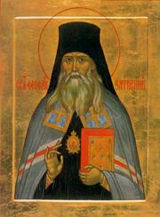
1815-1894 A.D. Commemorated ___
St. Theophan the Recluse (also known as Theophan Zatvornik) was born George Vasilievich Govorovon January 10, 1815, in the village of Chernavsk, located in the Orel Region of Russia. As the son of a priest, Theophan was steeped in the traditions of Orthodoxy from his youth, about which he wrote later that it is the most beneficial factor for the proper upbringing of children (Raising Them Right).
He attended the Orlov Seminary (1831-1837) and the Theological Academy of Kiev (1837-1841). While in Kiev, he visited the Lavra Monastery and the monastic caves around it, which constitute the glorious cradle of Russian monasticism. He was attracted by the monastic life and was tonsured a monk a few months before the end of his studies. In the same year (1841), he was ordained a deacon, and a short time later, a priest. After finishing his studies at the Academy, he taught philosophy, psychology, ethics, logic, and Latin in several schools. In 1847, he visited Mount Athos and studied Greek Orthodox Monasticism for seven years. In 1857, he became dean of the Theological Academy of St. Petersburg. In 1859, he was ordained a bishop of the province of Tambov, and later was assigned to the province of Vladimir. In 1866, after twenty-five years of fruitful service to the Church, he retreated in a poor monastery cell in the Vishensk desert to live there the remaining twenty-eight years of his life. The following is from his farewell speech to his flock:
“Do not get me wrong that I part from you. The love I have for you would not let me go, were it not for an irresistible longing for a loftier life…I will always pray that the Lord grant you every good, keep you from all calamity, secure your salvation…You have learned the path and the means of salvation. I can only remind you of the advice of the Apostle Paul to Timothy: ‘Keep what you have received.’ Guard against false teachers. Stay away from all those who do not agree with what the Church teaches, no matter what position or titles they may have… Correct faith attracts Divine Grace. With its help, the pure in soul can see God even in this life and can have a foretaste of the blessedness to come.”
St. Theophan was a prolific writer. A comment by Leo Tolstoi’s sister is in fact indicative: “Two of our contemporaries wrote much: my brother Leo and bishop Theophan. The difference being that the former wrote unto perdition of souls, whereas the latter unto salvation.”
St. Theophan’s works are divided into ethics, hermeneutics, and translations. He translated the famous text of the Philokalia from Greek into Russian. In addition, thousands of letters on various issues came to his cell from all over Russia, and he tried to reply to all of them. His cell became a beacon of Orthodox spirituality. Though the fervent sermons of the brilliant bishop had ceased, his letters and writings flooded the vast Russian land.
He fell asleep in the Lord in 1894. One century later, the Holy Synod of the Church of Russia formally proclaimed his sainthood.
Theophan was instrumental in translating the Philokalia from Church Slavonic into Russian. He wrote several commentaries on the Scriptures and adapted earlier texts of the Syriac fathers. His letters on spiritual direction comprise more than ten volumes, and has also written some amazingly insighful reflections in Raising Them Right, the Path to Salvation, and Turning the Heart to God - all available at Conciliar Press (PO Box 76, Ben Lomond, CA 95005; 1-800-967-73377).
Saint John Maximovitch of Shanghai & San Francisco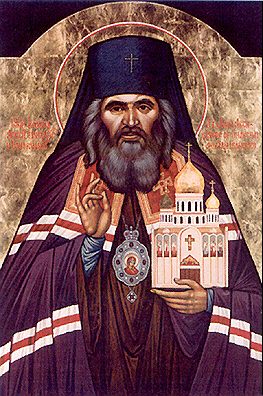
1896-1966 A.D. Commemorated Jun. 18 / Jul. 2
"Sanctity is not simply virtuousness. It is the attainment of such a spiritual height that the abundance of God's grace, filling the saint, overflows on those who associate with him. Great is the blessedness of saints in which they dwell contemplating the glory of God. Full of love for God and man, they are responsive to man's needs, interceding before God and helping those who turn to them." Characterizing the ancient Saints with such words Vladika John simultaneously summarized also his own spiritual aspiration which made him one of the greatest Saints of our time.
Childhood
ARCHBISHOP JOHN was born on June 4, 1896, in the village of Adamovka in the province of Kharkov in southern Russia. He was a member of the Little Russian noble family of Maximovitch, to which St. John of Tobolsk also had belonged. He received at baptism the name of Michael, his heavenly protector being the Archangel Michael. He was a sickly child and ate little. He received his secondary education in the Poltava Military School, which he attended from 1907 to 1914. Upon completing military school he entered Kharkov Imperial University in the faculty of law, from which he graduated in 1918, before it was seized by the Soviets.
Kharkov, where Vladika spent his formative years, was a true town of Holy Russia, and the young Michael, impressionable to revelations of holiness, acquired there the pattern of his future life. There were two miraculous Icons of the Mother of God, the Oseryanskaya and Eletskaya, which were carried in a religious procession twice a year from the monasteries where they were treasured to the Dormition Cathedral. In the Protection Monastery, in a frescoed grotto underneath the altar, lay the remains of the holy Archbishop Melety Leontovitch, who after his death in 1841 rendered miraculous help to those who served a panikhida for him at his coffin. Even during his lifetime the Archbishop was venerated for his severe asceticism, especially for the ascetic feat of abstaining from sleep. He was known to spend nights on end standing motionless, with lifted arms, deep in prayer. He foreknew the day and the hour of his own death. The young Maximovitch was known to have a veneration for this holy hierarch.
Today Archbishop John may be seen to resemble the holy man of Kharkov in at least three respects: he was known not to have slept in a bed for forty years; he knew beforehand of his death; and before his glorification in 1994 his relics rested under a cathedral in a special grave-chapel where panikhidas were sung almost daily and the Psalter read over his coffin by those asking for his help. This is a unique case of the transplanting, as it were, of a part of Holy Russia to contemporary America.
While at Kharkov University, Vladika spent more time reading the lives of the saints than attending classes; nonetheless he was an excellent student. Evidently his emulation of saints was apparent even at that age, since Archbishop Anthony of Kharkov, one of the great Church figures of that time (later Metropolitan Anthony Hrapovitsky, the first Chief Hierarch and founder of the Russian Church Abroad) took special pains to become acquainted with him, and then kept the youth close to him and guided his spiritual formation.
Belgrade
IN 1921, DURING THE RUSSIAN CIVIL WAR, Vladika, together with his parents, his brothers, and his sister, was evacuated to Belgrade, where he and his brothers entered the University of Belgrade. One brother graduated in the technical faculty and became an engineer, the other graduated in law and served in the Yugoslav police. Vladika himself graduated in 1925 in the faculty of theology. While he was a student he worked for his living by selling newspapers.
In 1924 Vladika was ordained reader in the Russian church in Belgrade by Metropolitan Anthony, who continued to exert great influence over him; and Vladika in his turn showed the utmost respect and devotion to his superior. In 1926 Metropolitan Anthony tonsured him a monk and ordained him hierodeacon in the Milkov Monastery, giving him the name John, after Vladika's own distant relative, Saint John (Maximovitch) of Tobolsk. On November 21 of the same year Vladika was ordained hieromonk.
The city of Bitol was in the diocese of Okhrida. At that time the ruling bishop of this diocese was Nicholas Velimirovich - a noted preacher, poet, writer, and insirer of the popular religious movement. He, as much as Metropolitan Anthony, valued and loved the young Hieromonk John, and himself exerted a beneficial influence upon him. More than once he was heard to say, "If you wish to see a living saint, go to Bitol to Father John." For, indeed, it began to become evident that this was an entirely extraordinary man. It was his own students who first discovered what was perhaps Vladika's greatest feat of asceticism. They noticed at first that he stayed up long after everyone else had gone to bed; he would go through the dormitories at night and pick up blankets that had fallen down and cover the unsuspecting sleepers, making the Sign of the Cross over them. Finally it was discovered that he scarcely slept at all, and never in a bed, allowing himself only an hour or two each night of uncomfortable rest in a sitting position, or bent over on the floor praying before icons. Years afterward he himself admitted that since taking the monastic vows he had not slept lying in a bed. Such an ascetic practice is a very rare one; and yet it is not unknown to Orthodox tradition.
Archbishop Averky of the Jordanville Holy Trinity monastery, then a young hieromonk in Carpatho-Russia, witnessed the deep impression Hieromonk John made upon the seminary students. When they returned home on vacations they would speak of their extraordinary instructor who prayed constantly, served the Divine Liturgy or at least received Holy Communion every day, fasted strictly, never slept lying down, and with true fatherly love inspired them with the high ideals of Christianity and of Holy Russia.
In 1934 it was decided to raise Hieromonk John to the rank of bishop. As for Vladika himself, nothing was farther from his mind. A lady who knew him relates how she met him at this time on a streetcar in Belgrade. He told her that he was in town by mistake, having been sent for in place of some other Hieromonk John who was to be consecrated bishop! When she saw him the next day he informed her that the situation was worse than he had thought: it was him they wished to make bishop! When he had protested that this was out of the question, since he had a speech defect and could not enunciate clearly, he had only been told that the Prophet Moses had the same difficulty.
The consecration occurred on May 28, 1934. Vladika was the last bishop of the very many to be consecrated by Metropolitan Anthony, and the extraordinarily high esteem in which that venerable hierarch held the new bishop is indicated in a letter which he sent to Archbishop Dimitry in the Far East. Himself declining an invitation to retire to China, he wrote: "Dear friend! I am very old and unable to travel ... But in place of myself, as my soul, as my heart, I am sending you Bishop John. This little, frail man, looking almost like a child, is in actuality a miracle of ascetic firmness and strictness in our time of total spiritual enfeeblement." Vladika was assigned to the Diocese of Shanghai, China.
Shanghai
VLADIKA ARRIVED IN SHANGHAI in late November 1934, on the Feast of the Entrance of the Mother of God into the Temple, and found a large cathedral uncompleted and a jurisdictional conflict to resolve. The first thing he did was to restore Church unity. He established contact with Serbs, Greeks, Ukrainians. He paid special attention to religious education and made it a rule to be present at the oral examinations of the catechism classes in all the Orthodox schools in Shanghai. He at once became a protector of various charitable and philanthropic societies and actively participated in their work, especially after seeing the needy circumstances in which the majority of his flock, refugees from the Soviet Union, were placed. He never went visiting for tea to the rich, but he was to be seen wherever there was need, regardless of times and weather. He organized a home for orphans and the children of needy parents, entrusting it to the heavenly protection of a Saint he highly venerated, St. Tikhon of Zadonsk, who loved children. Vladika himself gathered sick and starving children off the streets and dark alleys of Shanghai's slums. Beginning with eight children, the orphanage later housed up to a hundred children at one time, and some 1500 in all. When the Communists came, Vladika evacuated the whole orphanage, first to an island in the Philippines, and then to America.
It soon became apparent to his new flock that Vladika was a great ascetic. The core of his asceticism was prayer and fasting. He ate once a day at 11 p.m. During the first and last weeks of Lent he did not eat at all, and for the rest of this and the Christmas fast he ate only bread from the altar. His nights he spent usually in prayer, and when he finally became exhausted he would put his head on the floor and steal a few hours of sleep near dawn. When the time would come to serve Matins, someone would knock on the door, to no avail; they would open the door and find Vladika huddled on the floor in the icon-corner, overcome by sleep. At a tap on the shoulder he would jump up, and in a few minutes he would be in church for services - cold water streaming down his beard, but quite awake.
Vladika officiated in the cathedral every morning and evening, even when sick. He celebrated the Divine Liturgy daily, as he was to do for the rest of his life, and if for some reason he could not serve, he would still receive Holy Communion. No matter where he was, he would not miss a service. Once, according to a witness, "Vladika's leg was terribly swollen and the concilium of doctors, fearing gangrene, prescribed immediate hospitalization, which Vladika categorically refused. Then the Russian doctors informed the Parish Council that they released themselves of any responsibility for the health and even the life of the patient. The members of the Parish Council, after long pleas for mercy and threats of taking him by force, compelled Vladika to agree, and he was sent to the Russian Hospital in the morning of the day before the Feast of the Exaltation of the Holy Cross. By six o'clock, however, Vladika came limping to the cathedral on foot and served. In a day all the swelling was gone."
Vladika's constant attention to self-mortification had its root in the fear of God, which he possessed in the tradition of the ancient Church and of Holy Russia. The following incident, told by 0. Skopichenko and confirmed by many from Shanghai, well illustrates his daring, unshakable faith in Christ. "Mrs. Menshikova was bitten by a mad dog. The injections against rabies she either refused to take or took carelessly ... And then she came down with this terrible disease. Bishop John found out about it and came to the dying woman. He gave her Holy Communion, but just then she began having one of the fits of this disease; she began to foam at the mouth, and at the same time she spit out the Holy Gifts which she had just received. The Holy Sacrament cannot be thrown out. And Vladika picked up and put in his mouth the Holy Gifts vomited by the sick woman. Those who were with him exclaimed: `Vladika, what are you doing! Rabies is terribly contagious!' But Vladika peacefully answered: `Nothing will happen; these are the Holy Gifts.' And indeed nothing did happen."
By now it had become known that Vladika not only was a righteous man and an ascetic, but was also so close to God that he was endowed with the gift of clairvoyance and there were healings by his prayers. A striking account told by an eyewitness, Lidia Liu, testifies to Vladika's spiritual height. "Vladika came to Hong Kong twice. It's strange, but I, not knowing Vladika then, wrote him a letter asking him to help a widow with children, and I also asked him about some personal spiritual matter, but I never received an answer. A year passed. Vladika came to Hong Kong and I was in a crowd that went to meet him in church. Vladika turned to me and said, `It is you who wrote me the letter!' I was astonished, since Vladika had never seen me before."
"A moleben was sung, after which Vladika, standing before a lectern, was delivering a sermon. I was standing next to my mother, and we both saw a light surrounding Vladika down to the lectern - a radiance around him a foot wide. This lasted a rather long time. When the sermon was over, I, struck by such an unusual phenomenon, told what we had seen to our friend, who replied to us: `Yes, many faithful saw it.' My husband, who was standing a little way off, also saw this light."
A similar event occurred in 1939, when certain parishioner began to lose her faith due to many tribulations which had befallen her. Once, upon entering the Church during Vladika's service, she witnessed during the transubstantiation of the Holy Sacraments a little flame in the form of a large tulip descended into the Chalice. After this miracle her faith returned, and she began repenting of her faint-heartedness.
Vladika visited prisons and celebrated the Divine Liturgy for the convicts. On one occasion in Shanghai, Vladika John was asked to give communion to a dying man in a Russian hospital. This time he took another priest with him. On his arrival he spotted a gregarious young man in his twenties, playing a harmonica. This lad was to be discharged the next day. Vladika John called to him and said: "I want to give you communion right now." The young man immediately confessed his sins and received communion. The astonished priest asked Vladika why he did not go to the one dying, but tarried instead with an obviously healthy young man. Vladika answered: "He will die tonight, and the other, who is seriously ill, will live many years." It happened just as he foretold.
Vladika loved to visit the sick and did it every single day, hearing confessions and giving Holy Communion. If the condition of a patient should become critical, Vladika would go to him at any hour of the day or night to pray at his bedside. Here is one undoubted miracle among the many worked by Vladika's prayers; it was recorded and placed in the archives of the County Hospital in Shanghai.
L. D. Sadkovskaya was very much taken by the sport of horse racing. Once she was thrown off her horse; she hit her head on a rock and lost consciousness. She was brought to the hospital unconscious. A concilium of doctors agreed that her condition was hopeless and it was not likely that she would live until morning. The pulse was almost gone; the skull was fractured in places so that small pieces of the skull were pressing on the brain. In such a condition she would die on the operating table. Even if her heart would tolerate surgery and the result were successful, she would still remain deaf, dumb, and blind.
Her sister, after hearing all this, rushed to Bishop John in despair and begged him to save her sister. Vladika agreed. He came to the hospital and asked everyone to leave the room and prayed there for about two hours. Then he called the chief doctor and asked him to examine her again. How surprised the doctor was to discover that her pulse was normal! He agreed to perform the operation immediately, but only in the presence of Bishop John. The operation was successful, and the doctors were amazed when, after the operation, the patient regained consciousness and asked to drink. Soon she was released from the hospital and lived for many years a normal life.
Vladika visited the prison also, and celebrated the Divine Liturgy for the convicts on a primitive little table. But the most difficult task for a pastor is to visit the mentally ill and the possessed - and Vladika sharply distinguished between the two. Outside Shanghai there was a mental hospital, and Vladika alone had the spiritual power to visit these terribly sick people. He gave them Holy Communion, and they, surprisingly, received it peacefully and listened to him. They always looked forward to his visits and met him with joy.
Vladika possessed great courage. During the Japanese occupation the Japanese authorities tried in every way possible to bend the Russian colony to their will. Pressure was directed through the heads of the Russian Emigrant Committee. Two presidents of this Committee strove to maintain its independence, and as a result both were killed. Confusion and terror seized the Russian colony, and at that moment Vladika John, in spite of warnings from the Russians who were collaborating with the Japanese, declared himself the temporary head of the Russian colony.
During the Japanese occupation it was extremely dangerous to walk on the streets at night, and most people took care to be home by dark. Vladika, however, paying no heed to the danger, continued to visit the sick and needy at any hour of the night, and he was never touched.
In Shanghai, a voice teacher, Anna Petrovna Lushnikova, taught Vladika the proper method of breathing and pronunciation of words, thus helping him to better his diction. At the end of each lesson Vladika paid her 20 dollars. In 1945, during the war, she was gravely wounded and chanced to be in a French hospital. On a very stormy night, feeling that she might die, Anna Petrovna began asking the nurses to call Vladika John, who was in France, so that he would give her communion. The nurses refused since the hospital was locked up during the night due to war-time conditions. Anna Petrovna was beside herself and kept calling upon Vladika. Suddenly, around eleven o'clock in the evening, Vladika appeared in the ward. Unable to believe her eyes, Anna Petrovna asked Vladika, weather this was a dream or did he really come to her. Vladika smiled, prayed and administered communion to her. Following this she calmed down and slept. The next morning she felt cured. No one believed Anna Petrovna that Vladika visited her that night since the hospital was tightly secured. However, her ward neighbor substantiated the fact that she also saw Vladika. The greatest surprise was that under Anna Petrovna's pillow was found a 20 dollar bill. Thus Vladika left a material evidence of his visit.
A former Shanghai altar boy of Vladika's and presently Archpriest George Larin, relates: "Notwithstanding Vladika's strictness, all the altar boys loved him very much. To me, Vladika was an ideal whom I wished to emulate in every way. Thus, during Lent, I stopped sleeping in bed and lay on the floor, I stopped eating the usual meals with the family, but partook of bread and water in solitude ... My parents became worried and took me to Vladika. Hearing them out, the prelate asked the guard to go to the store and bring a sausage. To my tearful outcries to the fact that I did not wish to break Lent, the wise prelate admonished me to eat the sausage and to remember always that obedience to parents is more important than personal accomplishments. "How then shall I go on Vladika?' - I asked wishing albeit to "especially" apply myself. - "Go to Church as you always did, and at home do what your mother and father ask.' I remember how grieved I was then that Vladika did not assign to me some "special' deeds."
With the coming of the Communists, the Russians in China were forced once again to flee, most of them through the Philippine Islands. In 1949 approximately 5000 refugees from the Chinese mainland were living in an International Refugee Organization camp on the island of Tubabao in the Philippines. This island is located in the path of the seasonal typhoons which sweep through that part of the Pacific. During the 27-month period of the camp' s occupancy, the island was threatened only once by a typhoon, and it changed course and bypassed the island.
When the fear of typhoons was mentioned by one Russian to the Filipinos, they replied that there was no reason to worry, because "your holy man blesses your camp from four directions every night." They referred to Vladika John; for no typhoon struck the island while he was there. After the camp had been almost totally evacuated and the people resettled elsewhere (mainly in the USA and Australia), it was struck by a terrible typhoon that totally destroyed the camp.
Paris
VLADIKA HIMSELF went to Washington, D. C., to get his people to America. Legislation was changed and almost the whole camp came to the New World - thanks again to Vladika. The exodus of his flock from China accomplished, Archbishop John was given in 1951 a new field for his pastoral endeavor: he was sent by the Synod of Bishops to the Archdiocese of Western Europe, with his see first in Paris, and later in Brussels. He was now one of the leading hierarchs of the Russian Church, and his attendance was frequently required at the sessions of the Synod in New York City.
In Western Europe Vladika took a deep interest not only in the Russians in the Diaspora, for whom he exerted himself tirelessly in labors similar to those for which he had been known in Shanghai, but also in the local inhabitants. He received under his jurisdiction local Dutch and French Orthodox Churches, protecting them and encouraging their Orthodox development. He celebrated the Divine Liturgy in Dutch and French, as before he had served in Greek and Chinese, and as later he was to serve in English. Vladika's interest in and devotion to the Church's Saints, of whom his knowledge was already seemingly limitless, was extended now to Western European Saints dating from before the schism of the Latin Church, many of whom, venerated only locally, were included in no Orthodox calendar of Saints. He collected their lives and images of them, and later submitted a long list of them to the Synod.
From this period of Vladika's presence in Western Europe, Mrs. E. G. Chertkova reminisces: "On several occasions I visited Vladika when he lived in the Cadet Corps building near Paris. He had a small cell on the top floor. In the cell were a table, an armchair and several chairs and in the corner - icons and a lectern with books. There was no bed in the cell since Vladika did not lie down to sleep, but prayed by leaning on a tall stick with a cross-bar on top. Sometimes he prayed on his knees; most likely when he prostrated himself he would then fall asleep for a little while in that position on the floor. That is how he exhausted himself! Sometimes during our conversation it seemed to me that he dozed. But when I stopped, he would immediately say: "Continue, I hear you.'" "Since for a long time our church did not have a permanent priest, once a priest from another parish came to us to celebrate Vespers. The whole service lasted only 45 minutes (usually it takes 2 and a half hours)! We were horrified! So many parts of Vespers were skipped that we decided to tell about this to Vladika. We hopped that he will influence the priest to follow the established order of Orthodox services. But Vladika pleasantly smiling said to us: `How difficult is to please you people. I celebrate too long and he too short!' With such kindness and meekness he taught us not to judge."
Vladika's reputation for holiness, too, spread among the non-Orthodox as well as the Orthodox population. In one of the Catholic churches of Paris, a priest strove to inspire his young people with these words: "You demand proofs, you say that now there are neither miracles nor saints. Why should I give you theoretical proofs, when today there walks in the streets of Paris a Saint - Saint Jean Nus Pieds (Saint John the Barefoot)." Many people testify to the miracles worked by the prayers of Archbishop John in Western Europe. V. D. recounts: "Many were aware that it was not necessary to ask Vladika to visit someone. The Lord Himself inspired him where and to whom to go. Vladika John was known to many in the French hospitals and was admitted therein at any time. Besides, Vladika unerringly directed himself where he was needed. My brother, when wounded in the head, was taken to the hospital. The x-ray revealed a large fracture of the skull. His eyes swelled and became sanguinous; he was in critical condition. Vladika, who did not know my brother, somehow found him in the hospital, prayed over him and gave him communion. When my brother underwent a follow up of head x-rays, there was no fracture to be found. My brother recuperated very fast. The doctor was dumbfounded!"
San Francisco
IN SAN FRANCISCO, WHOSE Cathedral of the Mother of God "Joy of All Who Sorrow" parish is the largest in the Russian Church Abroad, a life-long friend of Vladika, Archbishop Tikhon, retired because of ill-health, and in his absence the construction of a great new cathedral came to a halt as a bitter dispute paralyzed the Russian community. In response to the urgent request of thousands of Russians in San Francisco who had known him in Shanghai, Archbishop John was sent by the Synod in 1962 as the only hierarch likely to restore peace in the divided community. He arrived at his last assignment as bishop twenty-eight years to the day after his first arrival in Shanghai: on the feast of the Entrance of the Mother of God into the Temple, November 21, 1962.
Under Vladika's guidance a measure of peace was restored, the paralysis of the community was ended, and the cathedral finished. Yet even in the role of peacemaker Vladika was attacked, and accusations and slanders were heaped upon his head. He was forced to appear in public court - in flagrant violation of church canons - to answer to preposterous charges of concealing financial dishonesty by the Parish Council. All involved were completely exonerated; but thus Vladika's last years were filled with the bitterness of slander and persecution, to which he unfailingly replied without complaint, without judging anyone, with undisturbed peacefulness.
Vladika remained true to the end to his path of faithful service to the Church. To those who knew him in his last years perhaps two aspects of his character stood out. First was his strictness in what regarded the Church and the Law of God. At the end of October the Roman Catholic Church celebrates the feast of All Saints. There is a tradition that during the preceding night the dark spirits celebrated their own festival of disorder. In America this "celebration" called Halloween has become an occasion on which children make mischief dressed in costumes of witches, devils, ghosts, as if calling on the dark powers - a diabolic mockery of Christianity. A group of Russians organized on this night a Halloween Ball. In the San Francisco Cathedral at this time was the All-night Vigil celebrated, and a number of people were absent, to the great sorrow of Vladika. After the service Vladika went to the place where the ball was still in progress. He climbed the steps and entered the hall, to the absolute astonishment of the participants. The music stopped and Vladika, in complete silence, glared at the dumbfounded people, slowly and deliberately making the round of the entire hall, staff in hand. He spoke not a word, and none was necessary; the mere sight of Vladika stung the conscience of all, as was evident from the general consternation. Vladika left in silence; and the next day in church he thundered his holy indignation and his flaming zeal calling all to the devout Christian life.
Yet Vladika is not best remembered by his flock for his sternness, but rather for his gentleness, his joyfulness, even for what is known as "foolishness for Christ's sake." The most popular photograph of him captures something of this aspect of his character. It was especially noticeable in his conduct with children. After services he would smile and joke with the boys who served with him, playfully knocking the refractory on the head with his staff. Occasionally the Cathedral clergy would be disconcerted to see Vladika, in the middle of a service (though never in the altar), bend over to play with a small child! And on feast days when blessing with holy water was called for, he would sprinkle the faithful, not on the top of the head as is usual, but right in the face (which once led a small girl to exclaim, "he squirts you"), with a noticeable glint in his eye and total unconcern at the discomfiture of some of the more dignified. Children were absolutely devoted to him, despite his usual strictness with them.
Anna Hodyriva recounts: "My sister Xenia Yarovoy, who lived in Los Angeles, suffered for a long time with a painful hand. She sought physicians, tried home remedies, yet nothing helped. She finally decided to turn to Vladika John and wrote to him in San Francisco. Some time went by and the hand was healed. Xenia began to forget about the previous pain in her hand. On one occasion, when she visited San Francisco, she went to the Cathedral for services. At the end of the service Vladika John held the cross to be kissed. On seeing my sister he asked: `How is your hand?' Vladika saw my sister for the first time! How then did he recognize her and know that it was she who had a painful hand?"
Anna S. recollects: "My sister Musia and I got into an accident. A drunken young man was traveling towards us. He struck with great force the door on the side where my sister was sitting. The ambulance was called and she was taken to the hospital. Her condition was very serious - a lung was punctured and a rib broken, which caused her great pain. Her eyes were invisible in her swollen face. When Vladika visited her, she lifted her eyelid with her finger and upon seeing him took his hand and kissed it. She could not speak since she had a tracheotomy, but tears of joy flowed from her eyes. After that Vladika visited her several times and she began to get better. Once Vladika entered the ward and announced: `Musia is feeling very poorly now.' He then went to her and, closing the drape around her bed, he prayed for a long time. During his prayer we were approached by two physicians and I asked them how serious was my sister's condition and if I should summon her daughter from Canada? (we kept from the daughter the fact that her mother was in an accident). The physicians answered: `To call or not to call the family is your problem - we cannot guarantee that she will survive until the morning.' Thank God that she not only survived that night, but was completely cured and returned to Canada ... My family and I believe that Musia was saved by the prayers of Vladika John."
Vladika's life was governed by the standards of the spiritual life, and if this upset the routine order of things it was in order to jolt people out of their spiritual inertia and remind them that there is a higher judgment than the world's. A remarkable incident from Vladika's years in San Francisco (1963) illustrates several aspects of his holiness: his spiritual boldness based on absolute faith; his ability to see the future and to overcome by his spiritual sight the bounds of space; and the power of his prayer, which beyond all doubt worked miracles. The incident is related by the woman who witnessed it, Mrs. L. Liu; the exact words of Vladika were confirmed by the Mr. T. who is mentioned. "In San Francisco my husband was involved in an automobile accident and was seriously injured; he lost control of balance and suffered terribly. At this time Vladika had many troubles. Knowing the power of Vladika's prayers, I thought: "If I ask Vladika to come to my husband, my husband would recover;" But I was afraid to do this because Vladika was so busy then. Two days passed, and suddenly Vladika came to us, accompanied by Mr. B. T., who had driven him. Vladika stayed with us about five minutes, but I believed that my husband would recover. The state of his health was at its most serious point then, and after Vladika's visit there was a sharp crisis and then he began to recover and lived four more years after this. He was quite aged. Afterwards I met Mr. T. at a Church meeting and he told me that he had been driving Vladika to the airport. Suddenly Vladika had said to him: "Let's go now to the Liu's." He had objected that they would be late for the plane and that he could not turn around at that moment. Then Vladika had said: "Can you take the life of a man upon yourself?" He could do nothing but drive Vladika to us. Vladika, as it turned out, was not late for the plane."
The Death of a Saint
AMONG THOSE WHO KNEW and loved Vladika, the first response to the news of his sudden death was: it cannot be! And this was more than a reaction to the suddenness of the event; for among those who were close to him there had unaccountably developed the notion that this pillar of the Church, this holy man who was always accessible to his flock - would never cease to be! There would never be a time when one would not be able to turn to him for advice and consolation! In one sense, in a spiritual sense, this has since turned out to be true. But it is also one of the realities of this world that every man who lives must die. Vladika was prepared for this reality. To the manager of the orphanage where he lived, who had spoken in the spring of 1966 of a diocesan meeting to be held three years later, he indicated, "I will not be here then." In May, 1966, a woman who had known Vladika for twelve years and whose testimony, according to Metropolitan Philaret, is "worthy of complete confidence" was amazed to hear him say, "I will die soon, at the end of June - not in San Francisco, but in Seattle." Again, on the evening before his departure for Seattle, four days before his death, Vladika astonished a man for whom he had just served a moleben with the words, "You will not kiss my hand again." And on the day of his death, at the conclusion of the Divine Liturgy which he celebrated, he spent three hours in the altar praying, emerging not long before his death, which occurred on July 2, 1966. He died in his room in the parish building next to the church. He was heard to fall and, having been placed in a chair by those who ran to help him, breathed his last peacefully and with little evident pain, in the presence of the miracle-working Kursk Icon of the Sign.
Before the of canonization of Archbishop John his relics reposed in a chapel in the basement of the San Francisco cathedral (after the canonization in July of 1994 the relics of Archbishop John were moved to the main floor of the cathedral). Soon after his repose, a new chapter began in the story of this holy man. Just as St. Seraphim of Sarov told his spiritual children to regard him as living after his death, and to come to his grave and tell him what was in their hearts, so our Vladika also has proved to be hearing those who revere his memory. Soon after his death a one-time student of his, Fr. Amvrosy P., saw one night a dream or a vision: Vladika, clad in Easter vestments, full of light and shining, was censing the cathedral and joyfully uttered to him just one word while blessing him: "happy."
Later, before the end of the forty-day period, Fr. Constantine Z., long Vladika' s deacon and now a priest, who had lately been angry at Vladika and had begun to doubt his righteousness, saw Vladika in a dream all in light, with rays of light shining around his head so brightly that it was impossible to look at them. Thus were Fr. Constantine's doubts of Vladika's holiness dispelled.
The manager of the St. Tikhon Zadonsky Home and long a devoted servant of Vladika, M. A. Shakmatova, saw a remarkable dream. A crowd of people carried Vladika in a coffin into St. Tikhon's Church; Vladika came to life and stood in the royal doors anointing the people and saying to her, "Tell the people: although I have died, I am alive!" As during his life time, Vladika continues to be very active in helping those who need him. Here are just two of the thousands of cases of Vladika's miracles. Victor Boyton, who witnessed the healing of his friend by Vladika John, recounts: "The miracle occurred after I had received the copyright to the English publication of Orthodox Life from Jordanville, N.Y., which included photos of Vladika John. I had a friend, a Moslem from Russia, who was suffering from cancer of the blood and was losing his sight. The doctors concurred that in three months time he would be blind. Placing the picture of Vladika John by my vigil light, I began to pray daily for my friend. After a short period of time my friend was healed from the blood cancer and began to see normally. The eye doctors were amazed at this occurrence. From then on, my friend has lead a normal life and reads without impediment."
The archpriest Stephan Pavlenko recollects: "My brother Paul, although not in the military, lived for some years in Vietnam. There he sought children who were wounded or orphaned due to the then continuing war. He placed them either in orphanages or hospitals. Thus he became close with his future wife, a certain Vietnamese Kim En who was also involved with helping the unfortunate children. My brother introduced Kim to the Christian faith and to the lives of many of God's Saints. She told my brother that during her very difficult times there appeared to her in her dreams a certain monk who consoled her and told her what to do. Once, towards Easter time, I sent my brother some cassettes of monastic songs as well as some books and journals of a spiritual context. Having received my parcel and having shown the spiritual literature to Kim he was surprised, when upon seeing the cover of a certain journal she exclaimed: `This is the monk who appears to me in my sleep!' She pointed to a well known picture of Vladika John, taken among the graves of the Novo Diveevo monastery in Spring-Valley. In suit, Kim was baptized in the Orthodox Church with the name Kyra."
Epilogue
THE BLESSED ARCHBISHOP JOHN of Shanghai and San Francisco was canonized as a Saint by the Russian Church on July 2 1994. It was a wonderful and unforgettable event to which hundreds of clergy and many thousands of laymen came from all over the world!
The importance of St. John for the people of the 20th Century cannot be underestimated. Those who knew him personally or have read about his life and miracles have learned of the tremendous spiritual power embodied in this frail little man. God was drawn to the burning, loving heart of Vladika John, which became a vessel of His grace. He entrusted the Saint with heavenly secrets and the ability to transcend physical laws, making him a point of contact between Himself, the Creator, and us, His creatures. There can be no doubt that Vladika John has been sent by God as a gift of holiness to the people of the last days. At a time when imitation has become the norm in all aspects of life, when the authentic spirit of the Christian Faith has been so hidden that most are oblivious of its very existence, he can be seen as a model of genuineness.
Vladika John has set the right "tone" of true apostleship in the modern world. As more people are drawn into the Orthodox Church of Christ before the final unleashing of evil, may they look to him as their loving guide and a pastor who knows no death. He is a kind of "measuring stick" that indicates who and what is real in our confusing times. The unit of measure is nothing else than pure Christian love, which he possessed and distributed in abundance. With this love, the intense struggle of spiritual life becomes worth the effort. By the prayers of Saint John may God bless and save us. Amen!
Missionary Leaflet A12E
Published by Holy Protection Russian Orthodox Church
2049 Argyle Avenue
Los Angeles, CA 90068, USA
Saint Nicholas the Wonderworker of Myra & Lycia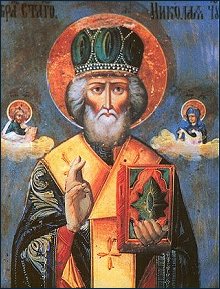
270-343 A.D. Commemorated Dec. 6 / Dec. 19
The Origin of the Christmas Stocking
One old man was so poor that he decided to send his three beautiful daughters into the streets to make a living. Finding out about this, St. Nicholas came secretly at night and threw some gold coins tied in a stocking through the window. In the morning they found the money and gave thanks to God for saving them from misfortune.
Prayers offered to St Nicholas on behalf of our son Declan were clearly heard and answered in the miraculous disappearance of the deformed blood vessels detected by previous MRI and CAT scans just days after Declan was born. Glory be to God and His saints!
A more detailed look at St Nicholas...
The holy hierarch of Christ, Nicholas, the great wonderworker, a speedy helper and an extraordinary mediator before God, grew up in the land of Lycia. He was born in the town of Patara.[1] His parents, Theophanes and Nonna, were pious people, prominent and wealthy. This blessed couple, for their God-pleasing life, many alms and great virtues, were worthy to raise a branch holy and like the tree which is planted by the streams of the waters, which shall bring forth its fruit in its season.[2]
When this blessed youth was born, he was given the name Nicholas, which means conqueror of nations. And he, by the blessing of God, truly appeared as a conqueror of evil, for the good of the whole world. After his birth, his mother Nonna was immediately free of pain and from that time until her death remained barren. By this nature itself bore witness that this woman could not have another son, similar to St. Nicholas: he alone should be the first and the last. Sanctified already while in his mother's womb by the grace of God, he showed himself to be a reverent venerator of God be/ore he saw the light of day; he began to perform miracles earlier than he began to feed on his mother's milk, and was a taster before he was accustomed to eat food.
After his birth, while still in the baptismal font, he stood on his feet for three hours, supported by no one, by this rendering honor to the Holy Trinity, of Whom he later would show himself to be a great servitor and intercessor. In him it was possible to recognize the future wonderworker even by the war in which he drew near to his mother's breast, because he led on the milk only of the right breast, signifying by this his future standing on the right hand of the Lord together with the righteous. He gave signs of his extraordinary abstinence in that on Wednesdays and Fridays he took his mother's milk only once, and this in the evening, after the parents' completion of the customary prayers.
His father and mother were much astonished and foresaw what a strict faster their son would be in his life. Being accustomed to such temperance from his swaddling clothes, St. Nicholas during his whole life until his death spent Wednesday and Friday in strict lasting. Growing with the years, the youth grew also in knowledge, perfecting himself in the virtues, in which he was taught by his pious parents. And he was like a fruitful field, receiving in itself and putting forth the good seed of instruction and bringing forth every day new fruits of good behavior. When the time came to learn the divine Scriptures, St. Nicholas, by the force and acuteness of his mind and the help of the Holy Spirit, in a little time attained much wisdom and succeeded in book-learning such as befits a good pilot of Christ's ship and a skillful shepherd of rational sheep. Having reached perfection in word and learning, he showed himself to be perfect in his very life. He by all means avoided vain friends and idle conversations, shunning conversation with women and didn't even look at them. St. Nicholas preserved a true chastity, with a pure mind always contemplating on the Lord and assiduously visiting the temple of God, following the Psalmist, who said: I have chosen rather to be an outcast in the house of my God.[3] In the temple of God he passed entire days and nights in lifting up his mind to God in prayer and in the reading of divine books, meditating on spiritual knowledge, enriching himself in the divine grace of the Holy Spirit and creating in himself a worthy dwelling for Him, in accordance with the words of the Scripture: Ye are the temple of God and the Spirit of God dwelleth in you.[4] The Spirit of God indeed dwelt in this virtuous and pure youth and, serving the Lord, he glowed with the Spirit. In him were noticed no habits natural to youth: in his moral disposition he was like an old man, because all esteemed him and marveled at him. An old man, if he shows youthful inclinations is a laughing-stock to everyone; on the other hand, if a youth has the disposition of an old man, he is esteemed by all with wonder. Inappropriate is youth in old age, but excellent and worthy of esteem is old age in youth.
St. Nicholas had an uncle, bishop of the town of Patara, having the same name as his nephew who was called Nicholas in his honor. This bishop, seeing that his nephew was successful in the virtuous life and by all means evaded the world, began to advise his parents that they should give their son to the service of God. These heeded this advice and consecrated to the Lord their child whom they themselves had received from Him as a gift. For in ancient books it is told concerning them that they were childless and already had no hope. of baring children, but by many prayers, tears, and deeds of mercy they begged of God a son for themselves, and now had no regret in bringing him as a gift to Him Who had given him. The bishop, receiving this old man in youth, who had gray hairs of wisdom and youth in old age, an undefiled life,[5] raised him to the rank of priest. When be ordained St. Nicholas a priest, then, by the inspiration of the Holy Spirit, addressing the people who were in the church, he pronounced a prophecy:
"I see, brethren, a new sun rising above the earth and manifesting in himself a gracious consolation for the afflicted. Blessed is the flock that will be worthy to have him as its pastor, because this one will shepherd well the souls of those who have gone astray, will nourish them on the pasturage of piety, and will be a merciful helper in misfortune and tribulation."
This prophecy was indeed later fulfilled, as will be evident from later narrative.
Having accepted the priestly rank, St. Nicholas added labors to labors; keeping vigil and remaining in unceasing prayer and lasting, he, being mortal, strove to imitate the bodiless ones. Leading a life equal to the angels and flowering from day to day all the more in beauty of soul, he was entirely worthy to rule in the church. At this time, Bishop Nicholas, desiring to go to Palestine for the veneration of the holy places, handed over the rule of the church to his nephew. This priest of God, St. Nicholas, having taken over the place of his uncle, took care of the at/airs of the church in the same way as the bishop himself. At this time his parents passed on to eternal life. Having obtained their estate in inheritance, St. Nicholas distributed it to the needy. For he paid no attention to temporal riches and did not concern himself with its increase, but, renouncing all earthly desires, with all his heart he strove to devote himself to the One God, crying: Unto Thee, O Lord, have I lifted up my soul. Teach me to do Thy will for Thou art my God. On Thee was I cast from the womb; from my mother's womb, Thou art my God.[6]
And his hand was outstretched to the needy, on whom it poured alms richly, as a water-filled river abounds in streams. Here is one of his many deeds of mercy.
There lived in the town of Patara a certain man, prominent and rich. Falling into extreme poverty, he lost his former prominence, because of the uncertain life of this age. This man had three daughters who were very beautiful in appearance. When he was already deprived of all necessities, so that there was nothing to eat and nothing to wear because of his great poverty, he planned to give his daughters to prostitution and turn his house into a brothel so that by this means he might obtain a livelihood for himself and acquire also food and clothing for himself and his daughters. O woe! To such unworthy thoughts does extreme misery lead! Having this unclean thought this man wanted already to fulfill his evil design. But the All-good Lord, not desiring to see a man in perdition and, in His love for mankind, helping in our misfortunes, placed a good thought in the mind of His servant, the holy priest Nicholas, and by inspiration sent him secretly to the man who was perishing in soul, for consolation in poverty and forewarning from sin. St. Nicholas, having heard of the extreme poverty of this man and knowing through revelation from God of his evil intention, felt great pity for him and decided to draw him out, together with his daughters, from poverty and sin, as from fire. However, he did not wish to show his good deed to this man openly, but intended to give generous alms secretly. St. Nicholas did thus for two reasons. On the one hand, he wanted to escape vain, human glory, following the words of the Gospel: Take heed that ye do not your alms before men;[7] on the other hand, he did not want to offend the man who once was rich and now had fallen into extreme poverty. For he knew how painful and insulting alms are to him who has fallen into pauperism, because it reminds him of his former prosperity. Therefore St. Nicholas considered it better to act according to the teaching of Christ: Let not thy left hand know what thy right hand doeth.[8] He so much shunned the praise of men that he tried to hide himself even from him whom he benefited. He took a large sack of gold, came at midnight to the house of that man and, throwing this sack in the window, hastened to return home. In the morning this man arose and, finding the sack, untied it. At the sight of gold, he fell into great consternation and did not believe his eyes, because from nowhere could he expect such a favor. However, in examining the money with his fingers, he was convinced that it was in fact gold before him. Having rejoiced in spirit and wondering at it, he wept for joy, for a long time he pondered over who could show him such a favor, and could think of nothing. Attributing this to the action of divine providence, he continually thanked his benefactor in his soul, rendering praise to the Lord Who cares for all. After this he gave his oldest daughter in marriage, giving her as dowry the gold miraculously given to him. St. Nicholas, knowing that this man acted according to his wishes, loved him and decided to do a like mercy also to the second daughter, intending by a lawful wedding to protect her also from sin. Preparing another sack of gold like the first one, he by night, hidden from all, by the same window threw it into the house of man. Arising in the morning, the poor man again found gold in his house. Again he was astonished and, falling to the earth and drenching himself with tears, he said:
"O merciful God, Author of our salvation, Who hast redeemed me by Thine Own Blood and now redeemest by gold my home and my daughters from the nets of the enemy, do Thou Thyself show me the minister of Thy mercy and Thy philanthropic goodness. Show me this earthly angel who preserves us from sinful perdition, so that I might know who hath snatched us from the poverty which oppresses us and delivers us from evil thoughts and intentions. O Lord, by Thy mercy secretly done for me by the generous hand of Thy servant unknown to me, I can give my second daughter lawfully in marriage and with this escape the snares of the devil, who desired by a tainted gain, or even without it, to increase my great ruin."
Having prayed 'thus to the Lord and having thanked Him for His goodness, this man celebrated the wedding of his second daughter. Hoping in God, the lather nourished undoubting hope that He would also grant a lawful husband to the third daughter, again secretly giving by a beneficent hand the gold necessary for it. In order to learn who brought gold to him, and whence, the father did not sleep for many nights, watching/or his benefactor and desiring to see him. Not much time passed when the awaited benefactor appeared. The servant of Christ, Nicholas, quietly came also a third time and, having stopped at the usual place, threw in the same window a similar sack of gold, and immediately hurried to his home. Hearing the clink of the gold thrown in the window, the man ran after the servant of God as rapidly as possible. Having caught up with him and recognizing him, because it was impossible not to know the saint by his virtues and illustrious origin, the man fell at his feet, kissing them and calling the saint a deliverer, a helper, and a savior of souls which came to the edge of ruin.
"If," said he, "the Lord great in mercy had not raised me up through thy generosity, then I, an unfortunate father, already long ago would he lost together with my daughters in the fire of Sodom. Now we are saved through thee and delivered from a horrible fall into sin."
And yet many similar words he tearfully said to the saint. Just after raising him from the earth, the holy servant of God took from him an oath that during his life he would tell no one about what had happened to him. Telling him yet many things to his profit, the saint dismissed him to his home.
Out of the many deeds of mercy of the servant of God we have related only one, so that it be known how merciful he was to the poor. Because there would not be enough time for us to tell about this in detail, how generous he was to the destitute, how many hungry he led, how many naked he clothed, and how many he ransomed from moneylenders.
After this, the holy lather Nicholas desired to go to Palestine, to see and venerate those holy places where our Lord God, Jesus Christ, walked with His most pure feet. When the ship sailed near Egypt and the travelers knew not what awaited them, St. Nicholas, who was among them, foresaw that soon a storm would arise and informed his fellow travelers of it, telling them that he had seen the devil himself entering the ship with the intent to drown all of them in the depths of the sea. And in this very hour unexpectedly the heavens were covered with clouds, and a powerful storm raised a terrible turbulence on the sea. The travelers tell into great terror, and having despaired of their salvation and expecting death, entreated holy lather Nicholas to help them who were perishing in the deep sea.
"If thou, O servant of God," they said, "do not help us by thy prayers to the Lord, then we shall immediately perish."
Commanding them to have courage, to place their hope in God and without any doubts to expect a speedy deliverance, the saint began to pray fervently to the Lord. Immediately the sea became peaceful, and a great calm set in, and the common sorrow turned into joy. The joyful travelers rendered thanksgiving to God and His servant, holy Father Nicholas, and were doubly astonished -- both at his foretelling of the storm and the cessation of distress. After this, one of the sailors had to climb to the top of the mast. In descending from there he slipped and fell from the very heights to the middle of the ship, killing himself and lying breathless. St. Nicholas, ready to help before it was needed, at once resurrected him by his prayer, and the man rose as if awaking from sleep. After this, hoisting all sails, the travelers happily continued their voyage, under favorable winds, and peacefully put in to shore at Alexandria. Healing here many ill and demon-possessed people and consoling the afflicted, the servant of God St. Nicholas again set out for Palestine according to his original plan.
Reaching the holy city of Jerusalem, St. Nicholas came to Golgotha, where Christ our God stretched out His immaculate hands and wrought salvation for the race of mankind. Here God's servant poured out prayers from a heart burning with love, sending up thanksgiving to our Savior. He went round all the holy places, making fervent veneration everywhere. And when at night he wanted to enter a holy church[9] for prayer, the closed doors of the church swung open by themselves, disclosing an unhindered entry to him for whom were opened also the heavenly gates. Having spent a long enough time in Jerusalem, St. Nicholas intended to seclude himself in the desert, but was restrained by a Divine voice from on high, which admonished him to return to his homeland. The Lord God Who orders everything to our profit, did not will that that luminary, who by the will of God needs must illuminate the metropolis of Lycia, should remain hidden under a bushel in the desert. Having arrived aboard ship, the servant of God made an agreement with the crew so that they would deliver him to his native land. But they schemed to deceive him and directed their ship not to Lycia, but to another land. When they sailed from the harbor, St. Nicholas, noticing that the ship sailed another way, fell at the feet of the seamen, beseeching them to direct the ship to Lycia. But they paid not the slightest attention to his entreaties and continued to sail along the charted route: they didn't know that God would not forsake His servant. And suddenly a storm swooped down, turned the ship in the other direction, and quickly carried it in the direction of Lycia, threatening the crew with complete destruction. Thus carried by Divine power over the sea, St. Nicholas finally arrived in his fatherland. In his good nature he did no evil to his perfidious enemies. He not only was not angry, but also did not accuse them by a single word, but dismissed them with a blessing to their own country. He himself came to the monastery founded by his uncle and called Holy Sion, and here he proved to be a welcome guest to the entire brotherhood. Receiving him with great love as an angel of God, they were delighted by his divinely-inspired speech and, imitating the good nature with which God had adorned His servant, learned from his angel-like life. Finding in this monastery a silent life and a peaceful haven for contemplation, St. Nicholas hoped also to spend the remaining time of his life here without going out. But God showed him a different way, because He did not desire so rich a treasure of' virtue, which ought to enrich the world, to remain cloistered in a monastery, like a treasure buried in the earth, but that it should be open to all and by him accomplish a spiritual purchase, acquiring many souls. And so, once, the saint, standing at prayer, heard a voice from on high:
"Nicholas, if you desire to be vouchsafed a crown from Me, go and struggle for the good of the world."
Hearing this, St. Nicholas was terrified and began to ponder over what this voice desired and required of him. And again he heard:
"Nicholas, here is not the field on which you must bring forth the fruit I expect; but turn back and go into the world and let My name be glorified in you.
Then St. Nicholas realized that the Lord needed him to forsake the podvig of silence and go into the service of people for their salvation.
He began to consider where he should go, either to his fatherland, the town of Patara, or to another place. Fleeing vainglory among his fellow citizens and tearing it, he thought of removing himself to another town where no one would know him. In this same Lycian land was the renowned city of Myra, which was the metropolis of all Lycia.[10] To this city came St. Nicholas, led by divine providence. Here he was known to no one; and he remained in this city as a pauper, having nowhere to lay his head. Only in the house of the Lord did he find shelter, having his only refuge in God. At that lime the bishop of this city, John, the archbishop and foremost hierarch of the entire land of Lycia, died. Consequently all the bishops of Lycia gathered in Myra in order to choose a worthy one for the vacant throne. Many respected and prudent men were nominated as successors to John. Among those who were doing the choosing there was a great discord, and certain among them, led by Divine zeal, said:
"The election of a bishop to this throne is not up to the decision of people, but is a matter of God's direction. It is proper for us to say prayers so that the Lord Himself will disclose who is worthy to receive such rank and be the shepherd of the whole land of Lycia."
This good counsel reel with general approval and all devoted themselves to fervent prayer and fasting. The Lord Who fulfills the desires of those that fear Him, attending to the prayer of the bishops then revealed to the oldest of them His good will. When this bishop stood at prayer, before him appeared a man in an image of light and commanded him to go to the doors of the church during the night and observe who will enter before everyone else.
"This," said He, "is My choice; receive him with honor and install him as archbishop; the name of this man is Nicholas."
The bishop informed the rest of the bishops about such a divine vision, and these, hearing this, increased their prayers. The bishop who had been considered worthy of the revelation stood in that place where it was ordered in the vision, and awaited the coming of the desired man. When the time came for the morning service, St. Nicholas, urged by the spirit, came to the church before all, for he was accustomed to rise at midnight for prayer and come earlier than the others for the morning service. As soon as he entered the narthex, the bishop who had been vouchsafed the revelation stopped him and asked him to tell his name. St. Nicholas remained silent. The bishop again asked him about his name. The saint meekly and softly answered him:
"My name is Nicholas, I am the servant of thy holiness, Master." The pious bishop, hearing such a brief and humble speech, understood by the very name -- Nicholas -- foretold him in vision, as well as by the humble and meek answer, that before him was the very man whom God was pleased to have as foremost bishop of the church of Myra. For he knew from Holy Scripture that the Lord takes care of the meek, the silent, and those who tremble before the word of God. With great joy he rejoiced, as if he had received some secret treasure. Immediately taking St. Nicholas by the hand, he told him: "Follow me, child."
When with honor he led the saint to the bishops, they were filled with divine delight, and being relieved in spirit that they had found the man indicated by God Himself, they conducted him to the church. Rumor about this spread everywhere and innumerable multitudes of people flocked swifter than birds to the church. The bishop who had been deemed worthy of the vision addressed the people and exclaimed:
"Brethren, receive your shepherd whom the Holy Spirit Himself anointed and to whom He entrusted the care of your souls. He was not appointed by an assembly of men, but by God Himself. Now we have the one that we desired, and have found and accepted the one we sought. Under his rule and instruction we will not lack the hope that we will stand before God in the day of His appearing and revelation."
All the people gave thanks to God and rejoiced with ineffable joy. Not being able to endure the praise of men, for a long time St. Nicholas refused to accept the sacred office; but yielding to the ardent requests of the council of bishops and all the people, he ascended the episcopal throne against his will. To this he was impelled by a Divine vision which he had yet before the death of Archbishop John. Concerning this vision St. Methodius, patriarch of Constantinople, relates. Once -- he said -- St. Nicholas saw at night that before him stood the Savior in all His glory and gave him a Gospel ornamented with gold and pearls. On the other side of himself St. Nicholas saw the most holy Theotokos who placed on his shoulders the episcopal omophorion. After this vision a few days passed, and Archbishop John of Myra died.
Recalling this vision and seeing in it the clear will of God, and not wishing to refuse the fervent entreaties of the council, St. Nicholas accepted the flock. The council of bishops with all the church clergy performed over him the ordination and joyously celebrated, made glad by the shepherd given of God, Nicholas, the hierarch of Christ. By this means the Church of God received a bright lamp which did not remain under a bushel, but was set on the episcopal and pastoral place proper to him. Having been honored with this great office, St. Nicholas rightly divided the word of truth and wisely guided his flock in the teaching of faith.
In the beginning of his pastorship the servant of God said to himself thus:
"Nicholas! The rank received by you requires different habits, so that you live not for yourself but for others."
Desiring to instruct his rational sheep in the virtues, he did not hide his virtuous life as before. For formerly, he passed his life secretly serving God Who Alone knew his ascetic feats. But now, after receiving the episcopal office, his life was open to all, not by vainglory before the people, but for their benefit and the increase of God's glory, so that the word of the Gospel be fulfilled: "Let your light so shine before men that they may see your good works and glorify your Father Who is inheaven.[11] By his good deeds St. Nicholas was like a mirror for his flock and, according to the word of the apostle, "an example of the believers, in word, in conversation, in love, in spirit, in faith, and in purity.[12] In character he was meek and forgiving, humble of spirit, and shunned all vainglory. His clothing was simple, his food - lasting fare, which he always ate only once a day, and that in the evening. All the day long he spent in labor proper to his office, listening to the requests and needs of those who came to him. The doors of his house were open to all. He was kind and affable to all, to orphans he was a father, to the poor a merciful giver, to the weeping a comforter, to the wronged a helper, and to all a great benefactor. To assist in him in the ruling of the church he chose two virtuous and prudent counselors who were invested with priestly rank. These were men well-known in all of Greece -- Paul of Rhodes and Theodore of Ascalon.
So St. Nicholas tended the flock entrusted to him, the rational sheep of Christ. But the envious evil serpent, never ceasing to incite war against the servants of God and not enduring the flourishing of piety among the people, raised persecution against the Church of Christ through the impious emperors Diocletian and Maximtan.[13] At this same time, from these emperors an order was sent all over the empire that Christians must renounce Christ and worship idols. Those who did not submit to this order were compelled to it by confinement in prison and severe tortures and, finally, given over to execution. This storm breathing evil, by the fervor of the zealots of darkness and ungodliness, soon reached also the city of Myra. The blessed Nicholas, who was the leader of all Christians in this city, freely and boldly preached the piety of Christ and was ready to suffer for Christ. For this he was seized by impious torturers and confined in prison together with many Christians. He remained not a little time, bearing severe suffering, enduring hunger and thirst and an overcrowded dungeon. He led his fellow prisoners on the word of God and quenched their thirst with the water of piety; confirming in them faith in Christ God, strengthening them on an indestructible foundation, he persuaded them to be firm in the confession of Christ and to suffer eagerly for the truth. By this time Christians again were given freedom, and piety shone forth, like the sun alter dark storm clouds, and like some calm coolness after a storm. For Christ the Lover of mankind, looking upon His inheritance, annihilated the ungodly, casting down Diocletian and Maximian from the imperial throne and destroying the power of the adherents of Hellenic impiety. By the appearance of His Cross to Constantine the Great, to whom He was pleased to entrust the kingdom of Rome, the Lord God "raised up a horn of salvation"[14] for His people. The Emperor Constantine, recognizing the One God and placing all his hope in Him, conquered all his enemies by the power of the precious Cross and ordered all temples of idols to be destroyed and Christian temples to be restored, and dispelled the vain hopes of his predecessors. He liberated all confined in prisons for Christ, and honoring them with great praises as courageous warriors, returned these confessors of Christ each to his fatherland. At this time also the city of Myra again received its shepherd, the great bishop Nicholas, who had been deemed worthy of the crown of martyrdom. Bearing in himself the Divine grace, he, as before, healed the passions and ailments of people, and not only of the faithful, but also the unbelievers. Because of the great grace of God that dwelt in him, many glorified him and were astonished at him and all loved him. For he shone with purity of heart and was endowed with all the gifts of God, serving his Lord in holiness and righteousness. At that time there remained still many Hellenic temples, to which impious people were attracted by devilish suggestion and many inhabitants of Myra remained in perdition. The archbishop of the Most High God, animated by Divine zeal, visited all these places, destroying and turning into dust the temples of the idols and purifying his flock from diabolical defilement. Thus fighting with evil spirits, St. Nicholas came to the temple ofDiana,[15] which was very large and richly adorned. presenting an agreeable dwelling for demons. St. Nicholas destroyed this polluted temple, leveled its high edifice to the ground and the very foundation of the temple, which was in the earth, he scattered in the air, taking up arms more against the demons than against the temple itself. The evil spirits, not enduring the arrival of the servant of God, uttered doleful cries, but, vanquished by the weapon of prayer of the unconquerable warrior of Christ, St. Nicholas, they were forced to flee from their habitation.
The right-believing Emperor Constantine, desiring to firmly establish the Christian Faith, commanded an ecumenical council to be convened in the city Nicea. The holy fathers of the council laid down the correct teaching, anathematized the Arian heresy, and together with it Arius[16] himself, confessing the Son of God of equal honor and essence co-everlasting with the Father, re-established peace in the holy Divine, Apostolic Church. St. Nicholas was also among the 318 fathers of the council. He stood courageously against the impious teachings of Arius, and together with the holy fathers of the council affirmed and taught all the dogmas of the Orthodox Faith. A monk, John, of the Studite Monastery relates concerning St. Nicholas that, animated like the Prophet Elias by zeal for God, he put the heretic Arius to shame at the council not only by word but also by deed, smiting him on the cheek. The fathers of the council were indignant at the saint and for his daring action decided to deprive him of his episcopal rank. But our Lord Jesus Christ Himself and His most-blessed Mother, beholding from on high the deed of St. Nicholas, approved His courageous action and praised his divine zeal. For some of the holy fathers of the council had a vision similar to the one the saint himself was vouchsafed even before his ordination to the episcopate. They saw that on one side of the saint stands Christ the Lord Himself with the Gospel, and on the other, the most pure Virgin Theotokos with an omophorion, and they give the hierarch the emblems of his rank, of which he was deprived. Understanding from this that the boldness of the saint was pleasing to God, the fathers of the council ceased to reprove the saint and rendered him honor as a great servant of God.[17] Returning from the council to his flock, St. Nicholas brought it peace and blessing. With his mellifluous mouth he taught the entire people sound instruction, cut off at the very root erroneous ideas and reasonings and, having exposed the embittered, senseless heretics deep-rooted in wickedness, expelled them from Christ's flock. As a wise farmer purifies all that is found on the threshingfloor or on a grindstone, selects the best grain, and plucks out the tares, so the prudent laborer on the threshingfloor of Christ, St. Nicholas, filled the spiritual granary with good fruit, scattered and swept away the tares of heretical deception from the wheat of the Lord. That is why the Holy Church calls him a fan blowing away the weedy teachings of Arius. And indeed he was a light for the world and salt of the earth, because his life was light and his words were salted with wisdom. This good shepherd took great care for his flock, in all of its needs, not only nourishing it on spiritual pasturage, but also providing for its bodily needs.
Once in the land of Lycia there was a great famine, and in the city of Myra there was an extreme shortage of food. Feeling pity for the unfortunate people who were perishing from hunger, God's bishop appeared at night in a dream to a certain merchant who happened to be in Italy, who loaded his entire ship with grain and intended to sail to another land. Giving him a pledge of three gold coins, the saint commanded him to sail to Myra and sell the grain there. Awaking and finding the gold in his hand, the merchant was frightened, amazed by such a dream which was accompanied by the miraculous appearance of money. The merchant did not dare to disobey the command of the saint, went to the city of Myra and sold out his bread to its inhabitants. At the. same time he did not hide from them the appearance of' St. Nicholas to him in a dream. Having acquired such consolation in hunger and listening to the tale of the merchant, the citizens gave glory and thanks to God and extolled their miraculous nourisher, the great Bishop Nicholas.
At that time in great Phrygia there arose a revolt. Having learned of it, the Emperor Constantine sent three commanders with their soldiers to pacify the rebellious region. These were the commanders Nepotian, Ursus, and Herpylion. With great haste they set sail from Constantinople and remained at one port of the diocese of Lycia which was called the Adriatic shore. Here there was a town. Since strong rough seas prevented their sailing farther, they remained in this harbor to wait for calm weather. During their stay certain soldiers, going ashore to purchase necessities, took a great deal by force. Since this happened often, the inhabitants of this town were embittered; as a consequence, at a place called Plakomata, there arose argument, strife, and abuse between them and the soldiers. Learning of this, the holy Bishop Nicholas himself' decided to travel to that town in order to quell the civil strife. Hearing of his arrival, all the citizens, together with the soldiers, went out to meet him and bowed down. The saint asked the commanders whence and whither they guarded the way. They told him that they were sent by the emperor to Phrygia to put down the revolt which had arisen there. The saint admonished them to hold their soldiers in submission and not to allow them to oppress the people. After this he invited the commanders into the city and cordially entertained them. The commanders, having disciplined the offending soldiers, stilled the revolt, and were honored with a blessing from St. Nicholas. When this happened, there arrived from Myra certain citizens lamenting and weeping. Falling at the feet of the saint, they asked him to defend the wronged, relating to him with tears that in his absence the ruler Eustathius, bribed by envious and evil people, condemned to death three men from their town, who were guilty of no crime.
"Our whole town," they said, "laments and weeps, and awaits your return, Master. For if you had been with us, then the ruler would not have dared to make such an unjust judgment."
Having heard about this, God's bishop began to grieve in soul, and in company with the commanders immediately set out on his way. Upon reaching the place, called "Leo," the saint met certain travelers and asked them whether they knew of those men condemned to death. They answered:
"We fell them on the field of Castor and Pollux, being dragged away to execution."
St. Nicholas went faster, rushing to prevent the death of those innocent men. Having reached the place of execution, he saw that a multitude of people was gathered there. The condemned men, with their afros bound crosswise and with faces covered, had already knelt on the ground, stretched out their bare necks and awaited the blow of the sword. The saint saw that the executioner, harsh and violent, had already drawn his sword. Such a spectacle threw all into horror and distress. Combining anger with meekness, Christ's saint passed freely among the people, without any fear snatched the sword from the hands of the executioner, threw it upon the ground and then set the condemned men free of their bonds. All this he did with great boldness, and no one dared to stop him, because his word was powerful and Divine power was apparent in his actions: he was great before God and all the people. The men, delivered from the death sentence, seeing themselves unexpectedly restored from near death to life, shed warm tears and uttered joyful cries, and the all the people assembled there gave thanks to their bishop. The ruler Eustathius arrived there and wanted to approach the bishop. But the servant of God turned away from him with disdain and when the ruler fell at his leer, he thrust him aside. Calling down upon him the vengeance of God, St. Nicholas threatened him with torment for his unjust rule and promised to tell the emperor of his deeds. Being denounced by his own conscience and frightened by the threats of the bishop, the ruler with tears begged for mercy. Repenting of his injustice and desiring reconciliation with the great Father Nicholas, he laid his guilt before the elders of the city, Simonides and Eudocius. But the lie could not be hid, because the bishop knew well that the ruler, being bribed with gold, condemned the innocent to death. For a long time the ruler begged him to forgive him, and only then, when, with great humility and tears he acknowledged his sin, did the servant of Christ grant him forgiveness.
At the sight of all that happened, the commanders who had remained together with the hierarch were amazed at the zeal and goodness of the great bishop of God. Having been vouchsafed of his prayers, and having received from him a blessing for their journey, they set out for Phrygia in order to fulfill the royal command given to them. Arriving at the place of the revolt, they quickly suppressed it, and having fulfilled the royal commission, they returned with joy to Byzantium. The emperors and all the grandees gave them great praise and honor, and they were deemed worthy to take part in the royal council. But evil people envying such fame of the commanders, conceived enmity against them. Having meditated evil against them, they came to Eulavius, the ruler of the city, and slandered those men, saying:
"The commanders counsel ill, because, as we have heard, they introduce innovations and mediate evil against the emperor."
In order to win over the ruler to their side, they gave him much gold. The ruler informed the emperor. Having heard about this, the emperor, without any investigation, ordered those commanders to be confined in prison, learning that they might run away secretly and fulfill their evil design. Languishing in jail, and conscious of their innocence, the commanders were perplexed as to why they were thrown in prison. After a short time, the slanderers began to fear that their slander and evil would come to light and they themselves might suffer. Therefore, they came to the ruler and fervently begged him that he not allow those men to live so long and hasten to condemn them to death. Ensnared in the nets of avarice, the ruler was obliged to carry out what was promised to the end. He immediately departed to the emperor and, like a messenger of evil, appeared before him with a sad lace and a sorrowful look. Along with this, he wished to show that he was very much concerned about the life of the emperor and truly devoted to him. Striving to incite the emperor's anger against the innocent, he began to hold forth with lying and cunning speech, saving:
"O Emperor, not one of those shut in prison wishes to repent. All of them persist in their evil design, not ceasing to plot intrigues against you. Therefore, command without delay to hand them over to torture, so that they may not anticipate us and accomplish their evil deed, which they planned against the military commanders and you."
Alarmed by these words the emperor immediately condemned the commanders to death. But because it was evening, their punishment was delayed until morning. The prison guard learned of this. Having privately shed many tears over such a disaster threatening the innocent, he went to the commanders and said to them:
"For me it would have been better if I had not known you and had not enjoyed pleasant conversation and repast with you. Then I would easily bear separation from you and would not lament in soul over the disaster coming upon you. Morning will come, and the final and horrible separation will overtake us. I already do not see your faces dear to me, and do not hear your voice, because the emperor ordered to execute you. Instruct me how to deal with your possessions while there is yet time, and death has not yet prevented you from expressing your will."
He interrupted his speech with sobs. Learning of their horrible sentence, the generals rent their clothing and tore their hear, saying:
"What enemy has begrudged us our lives? For the sake of what are we, like malefactors, condemned to execution? What have we done, for what is it necessary to hand us over to death?"
And they called upon their relatives and friends by name, setting God Himself' as their witness, that they had done no evil, and wept bitterly. One of them by the name of Nepotian recalled, regarding St. Nicholas, how he, having appeared in Myra as a glorious helper and good defender, delivered three men from death. And the commanders began to pray:
"O God of Nicholas, having delivered the three men from an unjust death, look now also upon us, for there can be no help from men. There hath come upon us a great disaster, and there is none who might deliver us from disaster. Our voice is cut off' before the departure of our soul from the body, and our tongue is parched, burnt up by the fire of our heartfelt distress, so that we are not able to offer prayer unto Thee. "Let Thy compassions quickly go before us, O Lord.[18] Rescue us out the hand of them that seek after our souls." Tomorrow they wish to kill us, but do Thou hasten to our aid and deliver us innocent ones from death."
Attending to the prayers of those who fear Him and, like a father, pouring out compassion on His children, the Lord God sent His saint and servant, the great Bishop Nicholas, as help to the condemned men. That night the saint of Christ appeared to the emperor in a dream and said:
"Arise quickly and release those commanders languishing in prison. They were slandered to you and they suffer guiltlessly."
The saint explained in detail every deed and added:
"If you do not obey me and do not let them go, then I will raise a revolt against you similar to the one that occurred in Phrygia and you will perish by an evil death."
Astounded at such boldness, the emperor began to wonder how this man dared to enter into the inner chamber at night, and said to him:
"Who are you that you dare to threaten us and our power?"
He replied: "My name is Nicholas, I am the bishop of the metropolis of Myra."
The emperor became confused and, arising, began to ponder upon what this vision meant. Meanwhile, on that night the saint appeared to the ruler Eulavius and informed him about the condemned men also. Awakening from sleep, Eulavius became frightened. While he thought on this vision, there came a messenger from the emperor and told him about what the emperor had seen in a dream. Hastening to the emperor, the ruler disclosed his vision to him, and both of them were amazed that they had seen one and the same thing. At once the emperor ordered the commanders brought to him from prison, and said to them:
"By what sorcery did you bring these dreams upon us? A very angry man appeared to us and threatened us, boasting to soon bring war upon us."
The commanders turned one to another in perplexity and, knowing nothing, looked at one another with distressed glances. Noticing this, the emperor was mollified and said: "Fear no evil, tell the truth."
With tears and sobs they replied: "O Emperor, we know nothing of sorcery and have designed no evil against your power, may the All-seeing Lord be a witness in this. If we are deceiving you, and you learn anything ill of us, then allow no favor or clemency either to us or to our relatives. From our fathers we learned to honor the emperor and be faithful to him before all things. Thus also now we faithfully defend your life and, as is proper to our rank, unswervingly fulfill your commands to us. Serving you with zeal, we subdued the revolt in Phrygia, stopped the civil strife, and demonstrated our courage sufficiently by this deed itself, as those witness to whom this is well-known. Your power heaped honors upon us before, and now you with anger set yourself against us and pitilessly condemned us to an agonizing death. And so, O Emperor, we think that we suffer only for our zeal toward you alone, for which we have been condemned and, instead of glory and honors which we had hoped to receive, the fear of death has overtaken us."
At this address the emperor became compassionate and repented of his rash behavior. For he began to tremble before the judgment of God and left embarrassment for his royal purple, seeing that he, being a lawgiver for others, was ready to make a lawless judgment. He looked compassionately upon the condemned men and conversed with them briefly. Listening to his speech with compunction, the commanders suddenly saw St. Nicholas sitting next to the emperor and, by signs, promising him forgiveness. The emperor interrupted their discourse and asked:
"Who is this Nicholas, and which men did he save? Tell me about it."
Nepotian related to him everything in the order of its occurrence.
Then the emperor, learning that St. Nicholas was a great servant of God, marveled at his boldness and his great zeal in defense of the wronged, freed those commanders and said to them:
"It is not I that grant you life, but the great servant of the Lord, Nicholas, whom you called upon for help. Go to him and offer him thanksgiving. Say to him also from me that 'I fulfilled your command that the servant of Christ be not angry with me.'"
With these words he handed them a golden Gospel, a golden censer ornamented with stones, and two lamps and ordered all this to be given to the church of Myra. Having received a miraculous escape, the commanders set out on their way at once. Arriving in Myra, they rejoiced and were glad that they were vouchsafed to see the saint again. They expressed great gratitude to St. Nicholas for his wonderful help and chanted:
"Lord, O Lord, who is like unto Thee? Delivering the beggar from the hand of them that are stronger than he." [19]
They gave generous alms to the needy and the paupers and returned home safely. Such are the works of God with which the Lord magnified His servant. The tame of them spread everywhere, as on wings, it reached across the sea and spread throughout the world, so that there was no place where people did not know of the great and wonderful miracles of the great bishop Nicholas, which he wrought by the grace given him by the Almighty Lord.
Once, travelers sailing by ship from Egypt to the land of Lycia encountered strong turbulent seas and storm. The sails were already torn by the hurricane, the ship was lashed by the blows of the waves, and all despaired of their deliverance. At this time they remembered the great bishop Nicholas, whom they had never seen but only heard of, that he is a speedy helper to all that call upon him in misfortune. They turned to him in prayer and began call upon him for aid. The saint immediately appeared to them, walked on to the ship, and said:
"You called upon me, and I have come to help you; be not afraid!" All saw that he took the helm and began to pilot the ship. As on that occasion when our Lord bade the winds and the sea,[20] the saint at once commanded the storm to cease, keeping in mind the words of the Lord:
"He that believeth on Me, the works that I do shall he do also."[21] Thus the true servant of the Lord commanded both the wind and the sea, and they were obedient to him. Afterwards, under favorable winds the travelers reached the city of Myra. Going ashore they went to the city, desiring to see him who had saved them from disaster. They met the saint on the way to church and, recognizing in him their benefactor, they fell at his feet, giving thanks to him. The wondrous Nicholas not only delivered them from danger and death, but also showed concern for their spiritual salvation. By his clairvoyance he saw in them with his spiritual eyes the sin of fornication, which separates man from God and leads him away from keeping the commandments of God, and said to them:
"Children, I beseech you, consider within yourselves and correct your hearts and thoughts for the pleasing of the Lord. For even if we have hidden things from many people and have reckoned ourselves righteous, yet nothing can be hidden from God. Therefore, hasten with all diligence to preserve sanctity of soul and purity of body. For thus saith the divine Apostle Paul: "Ye are the temple of God... if any man defile the temple of God, him shall God destroy.''[22]
Having instructed those men with edifying words, the saint dismissed them in peace. For the character of the saint was as a childloving father, and his countenance shone with Divine grace like an angel of God. From his face, as from the lace of Moses, emanated a bright ray, and to him who only looked at him there was great benefit. For him who was burdened with some kind of passion or affliction of soul, it was enough to fix his gaze on the saint in order to receive consolation in his sorrow; and he who conversed with him already improved in good. And not only Christians, but also non-believers, any of them came to hear the sweet and mellifluous discourses of the saint, came to compunction and, noting the evil of unbelief which was implanted in them since infancy and accepting in their heart the right word of truth, entered upon the way to salvation.
The great servant of God lived for many years in Myra, shining with Divine goodness, in the words of the Scripture: "He was as the morning star in the midst of a cloud, and as the moon at the full; as the sun shining upon the temple of the Most High God... and as lilies by the rivers of waters... and as precious myrrh making all fragrant.''[23] Having reached a ripe old age, the saint paid his debt to human nature and, after a short bodily illness, ended his temporal life well. With joy and psalmody he passed on to eternal blessed life, escorted by holy angels and met by choirs of saints. At his burial the bishops of LVcia gathered with all the clergy and monastics and a countless multitude of people from all cities. The precious body of the saint was laid with honor in the cathedral church of the diocese of Myra on the sixth day of the month of December.[24] Many miracles were performed by the holy relics of the servant of God. For his relics gushed forth a fragrant and healing myrrh with which the sick were anointed and received healing. For this reason people from all corners of the earth came to his tomb seeking healing for their diseases and receiving it. Because not only ailments of the body, but also of the soul, were healed, and evil spirits were expelled by this holy myrrh. For the saint warred against demons and conquered them not only during his life, but also after his repose, as he conquers also now'.
Several God-fearing men who lived at the mouth of the River Tanais, hearing of the myrrh-streaming and healing relics of the saint of Christ, Nicholas, which lay in Myra of Lycia, planned to sail there by sea for veneration of the relics. But the evil demon which was once cast out of the temple of Diana by St. Nicholas, seeing that the ship was being readied to sail to this great father, and being furious at the saint for the destruction of the temple and for his expulsion, plotted to prevent these men from accomplishing their planned journey and thus deprive them of holy things. He transformed himself into a woman carrying a vessel of oil, and said to them:
"I wanted to carry this container to the tomb of the saint, but I am very afraid of a sea journey because it is dangerous for a woman who is weak and suffering from a sickness of the stomach to sail on the sea. Therefore, I beg you, take this vessel, carry it to the tomb of the saint and pour oil into the lamp."
With these words the demon handed the vessel to the God-lovers. It is not known what demonic enchantments were mixed with that oil, but it was meant for the harm and destruction of the travelers. Not knowing the destructive effects of this oil, they fulfilled the request and, having taken the container, they put out to sea and sailed safely for a whole day. But in the morning a northerly wind arose and sailing became difficult for them. Being in distress during many days of unfavorable sailing, they lost patience from the continual rough seas and decided to turn back. They had already turned the ship in that direction when St. Nicholas appeared before them in a small boat and said:
"Where are you sailing to, men, and why, having abandoned your former course, are you turning back? You can calm the storm and make the journey easy for sailing. The devil's nets are hindering your voyage because the vessel of oil was given to you not by a woman, but by a demon. Throw the vessel into the sea, and immediately your voyage will begin to be successful."
Hearing this, the men threw the demonic vessel into the depths of the sea. Immediately black smoke and flames came out of it, the air was filled with a great stench, the sea opened up, the water boiled and began to bubble from the very depths, and the watery spray was like sparks of fire. Those people that stood on the ship were greatly frightened and screamed with terror, but the helper who had appeared to them commanded them to have courage and not be afraid, calmed the turbulent storm and, delivering the travelers from fear, made safe their voyage to Lycia. For at once a cool and fragrant wind blew upon them, and with gladness they successfully reached the desired city. Having venerated the myrrh-streaming relics of their speedy helper andintercessor, they offered thanks to Almighty God and celebrated a supplicatory hymn to the great Father Nicholas. After this they returned to their own country and told everyone everywhere of that which had happened to them on their journey.
Many great and marvelous wonders were performed on land and sea by this great servant. He helped those in distress, saved from drowning and brought out those in the depths of the sea, released from captivity and brought home those who were freed, delivered from bonds and prison, defended from being wounded by the sword, freed from death and gave many healings to many, sight to the blind, power to walk to the cripple, hearing to the deaf, the gift of speech to the dumb. He enriched many suffering in infirmity and extreme poverty, gave food to the hungry, and to all those in need he appeared as a ready helper, a warm intercessor and speedy mediator and defender. And even now he helps those that call upon him and delivers them from misfortune. His miracles it is impossible to count, as it is likewise impossible to describe all of them in detail. The East and the West know this great wonderworker, and his miracles are known to all the ends of the earth. May the Triune God, the Father, Son, and Holy Spirit, be glorified in him and may his holy name be extolled by the lips of all unto the ages. Amen.
FOOTNOTES
1 Patara was a maritime trading city in the province of LVcia (now Anatolia) in Asia Minor. It was founded by the Phoeniciansand is now in ruins.
2 Psalm 1:3.
3 Psalm 83:11.
4 1 Corinthians 3:16.
5 Wisdom 4:9.
6 Psalms 24:1; 142:11; 21:10.
7 Matthew 6:1.
8 Matthew 6:3.
9 It was a small church on Mt. Sion, the only one at that time in all Jerusalem, populated with heathens and bearing the name Aelia Capitolina. This church, according to tradition, was built in the house where the Lord Jesus Christ instituted the Mystery of Communion and where the Descent of the Holy Spirit upon the Apostles later occurred.
10 Myra (now Mira, in Turkish Dembre) was the main city of ancient Lycia and was located near the sea on the River Andracus, at the mouth of which was the port of Andriaca.
11 Matthew 5:16.
12 1 Timothy 4:12.
13 Emperors Diocletian and Maximian (284 to 305 AD) were co-rulers, the first ruled in the East and the second in the West. The persecution raised by Diocletian was distinguished for its special cruelty. It began in the city of Nicomedia where, on the very day of Pascha, upwards of 20,000 Christians were burned in the church.
14 Luke 1:69.
15 Artemis, otherwise Diana, a famous Greek goddess personifying the moon and considered to be the protectress of forests and the hunt.
16 Arius denied the Divinity of Jesus Christ and did not recognize His consubstantiality with the Father. Called by the Equal-of-the-Apostles Emperor Constantine, the First Ecumenical Council was convened in the year 325 under the chairmanship of the emperor himself and it introduced into Church use the Symbol of Faith, later supplemented and completed in the Second Ecumenical Council, which was held in Constantinople in 381 AD
17 According to the testimony of A.N. Muraviev, there is preserved in Nicea until now, even among the Turks, a tradition concerning this. In one of the forts of this city they point out the prison of St. Nicholas. Here, according to tradition, he was imprisoned because he struck Arius at the council, and was held in bonds until he was justified by heavenly judgment, which was marked by the appearance of a Gospel and an omophorion, as they are portrayed on icons of the saint (Letters from the East, St. Petersburg, 1851, part 1, pp. 106,107).
18 Psalm 78:8.
19 Psalm 34:11,12.
20 Matthew 8:26.
21 John 14:12.
22 1 Corinthians 3:16,17.
23 Ecclesiasticus 50:6-8.
24 The year of the death of St. Nicholas is not known precisely; according to some, the servant of God died in the year 341, but according to others, the year of his demise occurred between the years 345- 352 AD
Saint Mary of Egypt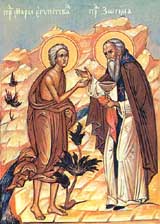
344-421 A.D. Commemorated Apr. 1 / Apr. 14
The Life of our Holy Mother Mary of Egypt
(From The Great Canon, the Work of Saint Andrew of Crete, Holy Trinity Monastery, Jordanville, NY, USA)
"It is good to hide the secret of a king, but it is glorious to reveal and preach the works of God" (Tobit 12:7) So said the Archangel Raphael to Tobit when he performed the wonderful healing of his blindness. Actually, not to keep the secret of a king is perilous and a terrible risk, but to be silent about the works of God is a great loss for the soul. And I (says St. Saphronius), in writing the life of St. Mary of Egypt, am afraid to hide the works of God by silence. Remembering the misfortune threatened to the servant who hid his God-given talent in the earth (Mat. 25:18-25), I am bound to pass on the holy account that has reached me. And let no one think (continues St. Saphronius) that I have had the audacity to write untruth or doubt this great marvel --may I never lie about holy things! If there do happen to be people who, after reading this record, do not believe it, may the Lord have mercy on them because, reflecting on the weakness of human nature, they consider impossible these wonderful things accomplished by holy people. But now we must begin to tell this most amazing story, which has taken place in our generation.
There was a certain elder in one of the monasteries of Palestine, a priest of the holy life and speech, who from childhood had been brought up in monastic ways and customs. This elder's name was Zosimas. He had been through the whole course of the ascetic life and in everything he adhered to the rule once given to him by his tutors as regard spiritual labours. he had also added a good deal himself whilst labouring to subject his flesh to the will of the spirit. And he had not failed in his aim. He was so renowned for his spiritual life that many came to him from neighboring monasteries and some even from afar. While doing all this, he never ceased to study the Divine Scriptures. Whether resting, standing, working or eating food (if the scraps he nibbled could be called food), he incessantly and constantly had a single aim: always to sing of God, and to practice the teaching of the Divine Scriptures. Zosimas used to relate how, as soon as he was taken from his mother's breast, he was handed over to the monastery where he went through his training as an ascetic till he reached the age of 53. After that, he began to be tormented with the thought that he was perfect in everything and needed no instruction from anyone, saying to himself mentally, "Is there a monk on earth who can be of use to me and show me a kind of asceticism that I have not accomplished? Is there a man to be found in the desert who has surpassed me?"
Thus thought the elder, when suddenly an angel appeared to him and said: "Zosimas, valiantly have you struggled, as far as this is within the power of man, valiantly have you gone through the ascetic course. But there is no man who has attained perfection. Before you lie unknown struggles greater than those you have already accomplished. That you may know how many other ways lead to salvation, leave your native land like the renowned patriarch Abraham and go to the monastery by the River Jordan."
Zosimas did as he was told. he left the monastery in which he had lived from childhood, and went to the River Jordan. At last he reached the community to which God had sent him. Having knocked at the door of the monastery, he told the monk who was the porter who he was; and the porter told the abbot. On being admitted to the abbot's presence, Zosimas made the usual monastic prostration and prayer. Seeing that he was a monk the abbot asked: "Where do you come from, brother, and why have you come to us poor old men?"
Zosimas replied: "There is no need to speak about where I have come from, but I have come, father, seeking spiritual profit, for I have heard great things about your skill in leading souls to God."
"Brother," the abbot said to him, "Only God can heal the infirmity of the soul. May He teach you and us His divine ways and guide us. But as it is the love of Christ that has moved you to visit us poor old men, then stay with us, if that is why you have come. May the Good Shepherd Who laid down His life for our salvation fill us all with the grace of the Holy Spirit."
After this, Zosimas bowed to the abbot, asked for his prayers and blessing, and stayed in the monastery. There he saw elders proficient both in action and the contemplation of God, aflame in spirit, working for the Lord. They sang incessantly, they stood in prayer all night, work was ever in their hands and psalms on their lips. Never an idle word was heard among them, they know nothing about acquiring temporal goods or the cares of life. But they had one desire -- to become in body like corpses. Their constant food was the Word of God, and they sustained their bodies on bread and water, as much as their love for God allowed them Seeing this, Zosimas was greatly edified and prepared for the struggle that lay before him.
Many days passed and the time drew near when all Christians fast and prepare themselves to worship the Divine Passion and Ressurection of Christ. The monastery gates were kept always locked and only opened when one of the community was sent out on some errand. It was a desert place, not only unvisited by people of the world but even unknown to them.
There was a rule in that monastery which was the reason why God brought Zosimas there. At the beginning of the Great Fast [on Forgiveness Sunday] the priest celebrated the holy Liturgy and all partook of the holy body and blood of Christ. After the Liturgy they went to the refectory and would eat a little lenten food.
Then all gathered in church, and after praying earnestly with prostrations, the elders kissed one another and asked forgiveness. And each made a prostration to the abbot and asked his blessing and prayers for the struggle that lay before them. After this, the gates of the monastery were thrown open, and singing, "The Lord is my light and my Savior; whom shall I fear? The Lord is the defender of my life; of whom shall I be afraid?" (Psalm 26:1) and the rest of that psalm, all went out into the desert and crossed the River Jordan. Only one or two brothers were left in the monastery, not to guard the property (for there was nothing to rob), but so as not to leave the church without Divine Service. Each took with him as much as he could or wanted in the way of food, according to the needs of his body: one would take a little bread, another some figs, another dates or wheat soaked in water. And some took nothing but their own body covered with rags and fed when nature forced them to it on the plants that grew in the desert.
After crossing the Jordan, they all scattered far and wide in different directions. And this was the rule of life they had, and which they all observed -- neither to talk to one another, nor to know how each one lived and fasted. If they did happen to catch sight of one another, they went to another part of the country, living alone and always singing to God, and at a definite time eating a very small quantity of food. In this way they spent the whole of the fast and used to return to the monastery a week before the Resurrection of Christ, on Palm Sunday. Each one returned having his own conscience as the witness of his labour, and no one asked another how he had spent his time in the desert. Such were rules of the monastery. Everyone of them whilst in the desert struggled with himself before the Judge of the struggle -- God -- not seeking to please men and fast before the eyes of all. For what is done for the sake of men, to win praise and honour, is not only useless to the one who does it but sometimes the cause of great punishment.
Zosimas did the same as all. And he went far, far into the desert with a secret hope of finding some father who might be living there and who might be able to satisfy his thirst and longing. And he wandered on tireless, as if hurrying on to some definite place. He had already waled for 20 days and when the 6th hour came he stopped and, turning to the East, he began to sing the sixth Hour and recite the customary prayers. He used to break his journey thus at fixed hours of the day to rest a little, to chant psalms standing and to pray on bent knees.
And as he sang thus without turning his eyes from the heavens, he suddenly saw to the right of the hillock on which he stood the semblance of a human body. At first he was confused thinking he beheld a vision of the devil, and even started with fear. But, having guarded himself with he sign of the Cross and banished all fear, he turned his gaze in that direction and in truth saw some form gliding southwards. It was naked, the skin dark as if burned up by the heat of the sun; the hair on its head was white as a fleece, and not long, falling just below its neck. Zosimas was so overjoyed at beholding a human form that he ran after it in pursuit, but re form fled from him. He followed. At length, when he was near enough to be heard, he shouted:
"Why do you run from an old man and a sinner? Slave of the True God, wait for me, whoever you are, in God's name I tell you, for the love of God for Whose sake you are living in the desert."
"Forgive me for God's sake, but I cannot turn towards you and show you my face, Abba Zosimas. For I am a woman and naked as you see with the uncovered shame of my body. But if you would like to fulfil one wish of a sinful woman, throw me your cloak so that I can cover my body and can turn to you and ask for your blessing."
Here terror seized Zosimas, for he heard that she called him by name. But he realized that she could not have done so without knowing anything of him if she had not had the power of spiritual insight.
He at once did as he was asked. He took off his old, tattered cloak and threw it to her, turning away as he did so. she picked it up and was able to cover at least a part of her body. The she turned to Zosimas and said:
"Why did you wish, Abba Zosimas, to see a sinful woman? What do you wish to hear or learn from me, you who have not shrunk from such great struggles?"
Zosimas threw himself on the ground and asked for her blessing. She likewise bowed down before him. And thus they lay on the ground prostrate asking for each other's blessing. And one word alone could be heard from both: "Bless me!" After a long while the woman said to Zosimas: "Abba Zosimas, it is you who must give blessing and pray. You are dignified by the order of priesthood and for may years you have been standing before the holy altar and offering the sacrifice of the Divine Mysteries."
This flung Zosimas into even greater terror. At length with tears he said to her: "O mother, filled with he spirit, by your mode of life it is evident that you live with God and have died to the world. The Grace granted to you is apparent -- for you have called me by name and recognized that I am a priest, though you have never seen me before. Grace is recognized not by one's orders, but by gifts of the Spirit, so give me your blessing for God's sake, for I need your prayers."
Then giving way before the wish of the elder the woman said: "Blessed is God Who cares for the salvation of men and their souls."
Zosimas answered: "Amen."
And both rose to their feet. Then the woman asked the elder: "Why have you come, man of God, to me who am so sinful? Why do you wish to see a woman naked an devoid of every virtue? Though I know one thing -- the Grace of the Holy Spirit has brought you to render me a service in time. Tell me, father, how are the Christian peoples living? And the kings? How is the Church guided?"
Zosimas said: "By your prayers, mother, Christ has granted lasting peace to all. But fulfill the unworthy petition of an old man and pray for the whole world and for me who am a sinner, so that my wanderings in the desert may not be fruitless."
She answered: "You who are a priest, Abba Zosimas, it is you who must pray for me and for all -- for this is your calling. But as we must all be obedient, I will gladly do what you ask."
And with these words she turned to the East, and raising her eyes to heaven and stretching out her hands, she began to pray in a whisper. One could not hear separate words, so that Zosimas could not understand anything that she said in her prayers. Meanwhile he stood, according to his own word, all in a flutter, looking at the ground without saying a word. And he swore, calling God to witness, that when at length he thought that her prayer was very long, he took his eyes off the ground and saw that she was raised bout a forearm's distance from the ground and stood praying in the air. When he saw this, even greater terror seized him and he fell on the ground weeping and repeating may times, "Lord have mercy."
And whilst lying prostrate on the ground he was tempted by a thought: Is it not a spirit, and perhaps her prayer is hypocrisy. But at the very same moment the woman turned round, raised the elder from the ground and said: "Why do thought confuse you, Abba, and tempt you about me, as if I were a spirit and a dissember in prayer? Know, holy father, that I am only a sinful woman, though I am guarded by Holy baptism. And I am no spirit but earth and ashes, and flesh alone."
And with these words she guarded herself with the sign of the Cross on her forehead, eyes, mouth and breast, saying: "May God defend us from the evil one and from his designs, for fierce is his struggle against us."
Hearing and seeing this, the elder fell to the ground and, embracing her feet, he said with tears: "I beg you, by the Name of Christ our God, Who was born of a Virgin, for Whose sake you have stripped yourself, for Whose sake you have exhausted your flesh, do not hide from your slave, who you are and whence and how you came into this desert. Tell me everything so that the marvellous works of God may become known. A hidden wisdom and a secret treasure -- what profit is there in them? Tell me all, I implore you. for not out of vanity or for self-display will you speak but to reveal the truth to me, an unworthy sinner. I believe in God, for whom you live and whom you serve. I believe that He led me into this desert so as to show me His ways in regard to you. It is not in our power to resist the plans of God. If it were not the will of God that you and you r life would be known, He would not have allowed be to see you and would not have strengthened me to undertake this journey, one like me who never before dared to leave his cell."
Much more said Abba Zosimas. But the woman raised him and said: "I am ashamed, Abba, to speak to you of my disgraceful life, forgive me for God's sake! But as you have already seen my naked body I shall likewise lay bare before you my work, so that you may know with what shame and obscenity my soul is filled. I was not running away out of vanity, as you thought, for what have I to be proud of -- I who was the chosen vessel of the devil? But when I start my story you will run from me, as from a snake, for your ears will not be able to bear the vileness of my actions. But I shall tell you all without hiding anything, only imploring you first of all to pray incessantly for me, so that I may find mercy on the day of Judgment."
The elder wept and the woman began her story. "My native land, holy father, was Egypt. Already during the lifetime of my parents, when I was twelve years old, I renounced their love and went to Alexandria. I am ashamed to recall how there I at first ruined my maidenhood and then unrestrainedly and insatiably gave myself up to sensuality It is more becoming to speak of this briefly, so that you may just know my passion and my lechery. for about seventeen years, forgive me, I lived like that. I was like a fire of public debauch. And it was not for the sake of gain -- here I speak the pure truth. Often when they wished to pay me, I refused the money. I acted in this way so as to make as many men as possible to try to obtain me, doing free of charge what gave me pleasure. do not think that I was rich and that was the reason why I did not take money. I lived by begging, often by spinning flax, but I had an insatiable desire and an irrepressible passion for lying in filth. This was life to me. Every kind of abuse of nature I regarded as life.
That is how I lived. Then one summer I saw a large crowd of Lybians and Egyptians running towards the sea. I asked one of them, `Where are these men hurrying to?' He replied, `They are all going to Jerusalem for the Exaltation of the Precious and Lifegiving Cross, which takes place in a few days.' I said to him, `Will they take me with them if I wish to go?' `No one will hinder you if you have money to pay for the journey and for food.' And I said to him, `To tell you truth, I have no money, neither have I food. But I shall go with them and shall go aboard. And they shall feed me, whether they want to or not. I have a body -- they shall take it instead of pay for the journey.' I was suddenly filled with a desire to go, Abba, to have more lovers who could satisfy my passion. I told you, Abba Zosimas, not to force me to tell you of my disgrace. God is my witness, I am afraid of defiling you and the very air with my words."
Zosimas, weeping, replied to her: "Speak on for God's sake, mother, speak and do not break the thread of such an edifying tale."
And, resuming her story, she went on: "That youth, on hearing my shameless words, laughed and went off. While I, throwing away my spinning wheel, ran off towards the sea in the direction which everyone seemed to be taking. and, seeing some young men standing on the shore, about ten or more of them, full of vigour and alert in their movements, I decided that they would do for my purpose (it seemed that some of them were waiting for more travellers whilst others had gone ashore). Shamelessly, as usual, I mixed with the crowd, saying, `Take me with you to the place you are going to; you will not find me superfluous.' I also added a few more words calling forth general laughter. Seeing my readiness to be shameless, they readily took me aboard the boat. Those who were expected came also, and we set sail at once.
How shall I relate to you what happened after this? Whose tongue can tell, whose ears can take in all that took place on the boat during that voyage! And to all this I frequently forced those miserable youths even against their own will. There is no mentionable or unmentionable depravity of which I was not their teacher. I am amazed, Abba, how the sea stood our licentiousness, how the earth did not open its jaws, and how it was that hell did not swallow me alive, when I had entangled in my net so many souls. But I think God was seeking my repentance. For He does not desire the death of a sinner but magnanimously awaits his return to Him. At last we arrived in Jerusalem. I spent the days before the festival in the town, living the save kind of life, perhaps even worse. I was not content with the youths I had seduced at sea and who had helped be to get to Jerusalem; many others -- citizens of the town and foreigners -- I also seduced.
The holy day of the Exaltation of the Cross dawned while I was still flying about -- hunting for youths. At daybreak I saw that everyone was hurrying to the church, so I ran with the rest. When the hour for the holy elevation approached, I was trying to make my way in with the crowd which was struggling to get through the church doors. I ad at last squeezed through with great difficulty almost to the entrance of the temple, from which the lifegiving Tree of the Cross was being shown to the people. But when I trod on the doorstep which everyone passed, I was stopped by some force which prevented by entering. Meanwhile I was brushed aside by the crowd and found myself standing alone in the porch. Thinking that this had happened because of my woman's weakness, I again began to work my way into the crowd, trying to elbow myself forward. But in vain I struggled. Again my feet trod on the doorstep over which others were entering the church without encountering any obstacle. I alone seemed to remain unaccepted by the church. It was as if there was a detachment of soldiers standing there to oppose my entrance. Once again I was excluded by the same mighty force and again I stood in the porch.
Having repeated my attempt three or four times, at last I felt exhausted and had no more strength to push and to be puched, so I went aside and stood in a corner of the porch. And only then with great difficulty it began to dawn on me, and I began to understand the reason why I was prevented from being admitted to see the life-giving Cross. The word of salvation gently touched the eyes of my heart and revealed to me that it was my unclean life which barred the entrance to me. I began to weep and lament and beat my breast, and to sigh from the depths of my heart. And so I stood weeping when I saw above me the ikon of the most holy Mother of God. And turning to her my bodily and spiritual eyes I said:
`O Lady, Mother of God, who gave birth in the flesh to God the Word, I know, O how well I know, that it is no honour or praise to thee when one so impure and depraved as I look up to thy ikon, O ever-virgin, who didst keep thy body and soul in purity. rightly do I inspire hatred and disgust before thy virginal purity. But I have heard that God Who was born of thee became man on purpose to call sinners to repentance. Then help me, for I have no other help. Order the entrance of the church to be opened to me. Allow me to see the venerable Tree on which He Who was born of thee suffered in the flesh and on which He shed His holy Blood for the redemption of sinners an for me, unworthy as I am. Be my faithful witness before thy son that I will never again defile my body by the impurity of fornication, but as soon as I have seen the Tree of the Cross I will renounce the world and its temptations and will go wherever thou wilt lead me.'
Thus I spoke and as if acquiring some hope in firm faith and feeling some confidence in the mercy of the Mother of God, I left the place where I stood praying. And I went again and mingled with the crowd that was pushing its way into the temple. And no one seemed to thwart me, no one hindered my entering the church. I was possessed with trembling, and was almost in delirium. Having got as far as the doors which I could not reach before -- as if the same force which had hindered me cleared the way for me -- I now entered without difficulty and found myself within the holy place. And so it was I saw the lifegiving Cross. I saw too the Mysteries of God and how the Lord accepts repentance. Throwing myself on the ground, I worshipped that holy earth and kissed it with trembling. The I came out of the church and went to her who had promised to be my security, to the place where I had sealed my vow. And bending my knees before the Virgin Mother of God, I addressed to her such words as these:
`O loving Lady, thou hast shown me thy great love for all men. glory to God Who receives the repentance of sinners through thee. What more can I recollect or say, I who am so sinful? It is time for me, O Lady to fulfil my vow, according to thy witness. Now lead me by the hand along the path of repentance!' And at these words I heard a voice from on high:
`If you cross the Jordan you will find glorious rest.' Hearing this voice and having faith that it was for me, I cried to the Mother of God: `O Lady, Lady, do not forsake me!'
With these words I left the porch of the church and set off on my journey. As I was leaving the church a stranger glanced at me and gave me three coins, saying: `Sister, take these.'
And, taking the money, I bought three loaves and took them with me on my journey, as a blessed gift. I asked the person who sold the bread: `Which is the way to the Jordan?' I was directed to the city gate which led that way. Running on I passed the gates and still weeping went on my journey. Those I met I asked the way, and after walking for the rest of that day (I think it was nine o'clock when I saw the Cross) I at length reached at sunset the Church of St. John the Baptist which stood on the banks of the Jordan. After praying in the temple, I went down to the Jordan and rinsed my face and hands in its holy waters. I partook of the holy and life-giving Mysteries in the Church of the Forerunner and ate half of one of my loaves. Then, after drinking some water from Jordan, I lay down and passed the night on the ground. In the morning I found a small boat and crossed to the opposite bank. I again prayed to Our Lady to lead me whither she wished. Then I found myself in this desert and since then up to this very day I am estranged from all, keeping away from people and running away from everyone. And I live here clinging to my God Who saves all who turn to Him from faintheartedness and storms."
Zosimas asked her: "How many years have gone by since you began to live in this desert?"
She replied: "Forty-seven years have already gone by, I think, since I left the holy city."
Zosimas asked: "But what food do you find?"
The woman said: "I had two and a half loaves when I crossed the Jordan. Soon they dried up and became hard as rock. Eating a little I gradually finished them after a few years."
Zosimas asked. "Can it be that without getting ill you have lived so many years thus, without suffering in any way from such a complete change?"
The woman answered: "You remind me, Zosimas, of what I dare not speak of. For when I recall all the dangers which I overcame, and all the violent thoughts which confused me, I am again afraid that they will take possession of me."
Zosimas said: "Do not hide from me anything; speak to me without concealing anything."
And she said to him: "Believe me, Abba, seventeen years I passed in this desert fighting wild beasts -- mad desires and passions. When I was about to partake of food, I used to begin to regret the meat and fish which of which I had so much in Egypt. I regretted also not having wine which I loved so much. for I drank a lot of wine when I lived in the world, while here I had not even water. I used to burn and succumb with thirst. The mad desire for profligate songs also entered me and confused me greatly, edging me on to sing satanic songs which I had learned once. But when such desires entered me I struck myself on the breast and reminded myself of the vow which I had made, when going into the desert. In my thoughts I returned to the ikon of the Mother of God which had received me and to her I cried in prayer. I implored her to chase away the thoughts to which my miserable soul was succumbing. And after weeping for long and beating my breast I used to see light at last which seemed to shine on me from everywhere. And after the violent storm, lasting calm descended.
And how can I tell you about the thoughts which urged me on to fornication, how can I express them to you, Abba? A fire was kindled in my miserable heart which seemed to burn me up completely and to awake in me a thirst for embraces. As soon as this craving came to me, I flung myself on the earth and watered it with my tears, as if I saw before me my witness, who had appeared to me in my disobedience, and who seemed to threaten punishment for the crime. And I did not rise from the ground (sometimes I lay thus prostrate for a day and a night) until a calm and sweet light descended and enlightened me and chased away the thoughts that possessed me. But always I turned to the eyes of my mind to my Protectress, asking her to extend help to one who was sinking fast in the waves of the desert. And I always had her as my Helper and the Accepter of my repentance. And thus I lived for seventeen years amid constant dangers. And since then even till now the Mother of God helps me in everything and leads me as it were by the hand."
Zosimas asked: "Can it be that you did not need food and clothing?"
She answered: "After finishing the loaves I had, of which I spoke, for seventeen years I have fed on herbs and all that can be found in the desert. The clothes I had when I crossed the Jordan became torn and worn out. I suffered greatly from the cold and greatly from the extreme heat. At times the sun burned me up and at other times I shivered from the frost, and frequently falling to the ground I lay without breath and without motion. I struggled with many afflictions and with terrible temptations. But from that time till now the power of God in numerous ways had guarded my sinful soul and my humble body. When I only reflect on the evils from which Our Lord has delivered me I have imperishable food for hope o of salvation. I am fed and clothed by the all-powerful Word of God, the Lord of all. For it is not by bread alone that man lives. And those who have stripped off the rags of sin have no refuge, hiding themselves in the clefts of the rocks (Job 24; Heb. 11:38)."
Hearing that she cited words Scripture, from Moses and Job, Zosimas asked her: "And so you have read the psalms and other books?"
She smiled at this and said to the elder: "Believe be, I have not seen a human face ever since I crossed the Jordan, except yours today. I have not seen a beast or a living being ever since I came into the desert. I never learned from books. I have never even heard anyone who sang and read from them. But the word of God which is alive and active, by itself teaches a man knowledge. And so this is the end of my tale. But, as I asked you in the beginning, so even now I implore you for the sake of the Incarnate word of God, to pray to the Lord for me who am such a sinner."
Thus concluding here tale she bowed down before him. And with tears the elder exclaimed: "Blessed is God Who creates the great and wondrous, the glorious and marvellous without end. Blessed is God Who has shown me how He rewards those who fear Him. Truly, O Lord, Thou dost not forsake those who seek Thee!"
And the woman, not allowing the elder to bow down before her, said: "I beg you, holy father, for the sake of Jesus Christ our God and Savior, tell no one what you have heard, until God delivers me of this earth. And how depart in peace and again next year you shall see me, and I you, if God will preserve us in His great mercy. But for God's sake, do as I ask you. Next year during Lent do not cross the Jordan, as is your custom in the monastery."
Zosimas was amazed to hear that she know the rules of the monastery and could only say: "Glory to God Who bestows great gifts on those who love Him."
She continued: "Remain, Abba, in the monastery. And even if you wish to depart, you will not be to do so. And at sunset of the holy day of the Last super, put some of the lifegiving Body and Blood of Christ into a holy vessel worthy to hold such Mysteries for me, and bring it. And wait for me on the banks of the Jordan adjoining the inhabited parts of the land, so that I can come and partake of the lifegiving Gifts. For, since the time I communicated in the temple of the Forerunner before crossing the Jordan even to this day I have not approached the Holy Mysteries. And I thirst for them with irrepressible love and longing. and therefore I ask and implore you to grant me my wish, bring me the lifegiving Mysteries at the very hour when Our Lord made His disciples partake of His Divine Supper. Tell John the Abbot of the monastery where you live. Look to yourself and to your brothers, for there is much that needs correction. Only do not say this now, but when God guides you. Pray for me!"
With these words she vanished in the depths of the desert. And Zosimas, falling down on his knees and bowing down to the ground on which she had stood, sent up glory and thanks to God. And, after wandering thorough the desert, he returned to the monastery on the day all the brothers returned.
For the whole year he kept silent, not daring to tell anyone of what he had seen. But in his should he pray to God to give him another chance of seeing the ascetic's dear face. and when at length the first Sunday of the Great Fast came, all went out into the desert with the customary prayers and the singing of psalms. Only Zosimas was held back by illness -- he lay in a fever. And then he remembered what the saint had said to him: "and even if you wish to depart, you will not be able to do so."
Many days passed and at last recovering from his illness he remained in the monastery. And when attain the monks returned and the day of the Last Supper dawned, he did as he had been ordered. and placing some of the most pure Body and Blood into a small chalice and putting some gis and dates and lentils soaked in water into a small basket, he departed for the desert and reached the banks of the Jordan and sat down to wait for the saint. He waited for a long while and then began to doubt. then raising his eyes to heaven, he began to pray: "Grant me O Lord, to behold that which Thou hast allowed be to behold once. do not let me depart in vain, being the burden of my sins."
And then another thought struck him: "And what is she does come? There is no boat; how will she cross the Jordan to come to me who am so unworthy?"
And as he was pondering thus he saw the holy woman appear and stand on the other side of the river. Zosimas got up rejoicing and glorifying and thanking God. And again the thought came to him that she could not cross the Jordan. Then he saw that she made the sign of the Cross over the waters of the Jordan (and the night was a moonlight one, as he related afterwards) and then she at once stepped on to the waters and began walking across the surface towards him. And when he wanted to prostrate himself, she cried to him while still walking on the water: "What are you doing, Abba, you are a priest and carrying the divine Gifts!"
He obeyed her and on reaching the shore she said to the elder: "Bless, father, bless me!"
He answered her trembling, for a state of confusion had overcome him at the sight of the miracle: "Truly God did not lie when He promised that when we purify ourselves we shall be like Him. Glory to The, Christ our God, Who has shown me through this thy slave how far away I stand from perfection."
Here the woman asked him to say the Creed and our Father. He began, she finished the prayer and according to the custom of that time gave him the kiss of peace on the lips. Having partaken of the Holy Mysteries, she raised her hands to heaven and sighed with tears in her eyes, exclaiming: "Now lettest Thou Thy servant depart in peace, O Lord, according to Thy word; for my eyes have seen Thy salvation."
Then she said to the elder: "Forgive me, Abba, for asking you, but fulfil another wish of mine. Go now to the monastery and let God's grace guard you. and next year come again to the same place where I first met you. come for God's sake, for you shall again see me, for such is the will of God."
He said to her: "From this day on I would like to follow you and always see your holy face. but now fulfil the one and only wish of an old man and take a little of the food I have brought for you."
And he showed her the basket, while she just touched the lentils with the tips of her fingers, and taking three grains said that the Holy spirit guards the substance of the soul unpolluted. Then she said: "Pray, for God's sake pray for me and remember a miserable wretch."
Touching the saint's feet and asking for her prayers for the Church, the kingdom and himself, he let her depart with tears, while he went off sighing and sorrowful, for he could not hope to vanquish the invincible. Meanwhile she again made the sign of the Cross over the Jordan, and stepped on to the waters and crossed over as before. And the elder returned filled with joy and terror, accusing himself of not having asked the saint her name. But he decided to do so next year. And when another year had passed, he again went into the desert. he reached the same spot but could see no sign of anyone. so raising his eyes to heaven as before, he prayed: "Show me, O Lord, Thy pure treasure, which Thou hast concealed in the desert. Show me, I pray Thee, the angel in the flesh, of which the world is not worthy."
Then on the opposite bank of the river, her face turned towards the rising sun, he saw the saint lying dead. Her hands were crossed according to custom and her face was turned to the East. Running up he shed tears over the saint's feet and kissed them, not daring to touch anything else. For a long time he wept. Then reciting the appointed psalms, he said the burial prayers and thought to himself: "Must I bury the body of a saint? Or will this be contrary to her wishes?" And then he saw words traced on the ground by her head: "Abba Zosimas, bury on this spot the body of humble Mary. Return to dust that which is dust and pray to the Lord for me, who departed in the month of Fermoutin of Egypt, called April by the Romans, on the first day, on the very night of our Lord's Passion, after having partaken of the Divine Mysteries." [St. Mary died in 522 A. D.]
Reading this the elder was glad to know the saint's name. He understood too that as soon as she had partaken of the Divine Mysteries on the shore of the Jordan she was at once transported to the place where she died. The distance which Zosimas had taken twenty days to cover, Mary had evidently traversed in an hour and had at once surrendered her soul to God.
Then Zosimas thought: "It is time to do as she wished. But how am I to dig a grave with nothing in my hands?" And then he saw nearby a small piece of wood left by some traveller in the desert. Picking it up he began to dig the ground. But the earth was hard and dry and did not yield to the efforts of the elder. He grew tired and covered with sweat. he sighed from the depths of his soul and lifting up his eyes he saw a big lion standing close to the saint's body and licking her feet. At the sight of the lion he trembled with fear, especially when he called to mind Mary's words that she had never seen wild beasts in the desert. But guarding himself with the sign of the cross, the thought came to him that the power of the one lying there would protect him and keep him unharmed. Meanwhile the lion drew nearer to him, expressing affection by every movement.
Zosimas said to the lion: "The Great One ordered that her body was to be buried. But I am old and have not the strength to dig the grave (for I have no spade and it would take too long to go and get one), so can you carry out the work with your claws? Then we can commit to the earth the mortal temple of the saint."
While he was still speaking the lion with his front paws began to dig a hole deep enough to bury the body.
Again the elder washed the feet of the saint with his tears and calling on her to pray for all, covered the body with earth in the presence of the lion. It was as it had been, naked and uncovered by anything but the tattered cloak which had been given to her by Zosimas and with which Mary, turning away, had managed to cover part of her body. Then both departed. The lion went off into the depth of the desert like a lamb, while Zosimas returned to the monastery glorifying and blessing Christ our Lord. And on reaching the monastery he told all the brothers about everything, and all marvelled on hearing of God's miracles. And with fear and love they kept the memory of the saint.
Abbot John, as St. Mary had previously told Abba Zosimas, found a number of things wrong in the monastery and got rid of them with God's help. And Saint Zosimas died in the same monastery, almost attaining the age of a hundred, and passed to eternal life. The monks kept this story without writing it down and passed it on by word of mouth to one another.
But I (adds Sophronius) as soon as I heard it, wrote it down. Perhaps someone else, better informed, has already written the life of the Saint, but as far as I could, I have recorded everything, putting truth above all else. may God Who works amazing miracles and generously bestows gifts on those who turn to Him with faith, reward those who seek light for themselves in this story, who hear, read and are zealous to write it, and may He grant them the lot of blessed Mary together with all who at different times have pleased God by their pious thoughts and labours.
And let us also give glory to God, the eternal King, that He may grant us too His mercy in the day of judgment for the sake of Jesus Christ our Lord, to Whom belongs all glory, honour, dominion and adoration with the Eternal Father and the Most Holy and Life-giving Spirit, now and always, and thought all ages. Amen.
The End and Glory Be to God
Troparion, tone 8
In thee, O Mother, was exactly preserved
what was according to the divine image.
for thou didst take the cross and follow Christ,
and by thy life, didst teach us to ignore the flesh, since it is transitory,
but to care for the soul as an immortal thing.
Therefore, thy spirit, St. Mary, rejoices with the Angels.
Kontakion, tone 4
Having escaped the fog of sin,
and having illumined thy heart with the light of penitence, O glorious one,
thou didst come to Christ and didst offer to Him
His immaculate and holy Mother as a merciful intercessor.
Hence thou hast found remission of transgressions,
and with the Angels thou ever rejoicest.
This version of the text is part of the Internet Medieval Source Book. The Sourcebook is a collection of public domain, copy-permitted and electronically available texts related to medieval and Byzantine history. Unless otherwise indicated the specific electronic form of the document is copyright. Permission is granted for electronic copying, distribution in print form for educational purposes and personal use. If you do reduplicate the document, indicate the source. No permission is granted for commercial use.
Paul Halsall Mar 1996
halsall@murray.fordham.edu /